
Objectives:
Objective 1: To know the meaning of Radha Madhav.
Objective 3: To understand the reason behind Srila Jayadev Goswami’s marriage.
Objective 4: To Know where and when Jayadeva wrote his poem “Dasha-avatara-stotra”.
Objective 7: To understand how Lord Krishna revealed His form of Gauranga to Jayadev and his wife.
Objective 8: To know when was Jayadev’s disappearance day.
Objective 10: To understand about Radha Madhav Temple in Jaipur, its features and its location
Objective 11: To know about the timing of Kanak Vrindavan Temple at Kanak Ghati.
Objective 12: To know the the other deities housed in the Shri Radha Madhav Mandir in Jaipur.
Objective 1: To know the meaning of Radha Madhav.
The name Madhav is a very prominent name for both Lord Vishnu and Lord Krishna. Srila Prabhupada writes in his Nectar of Devotion: “According to Sri Jiva Goswami the names of both Radha and Krishna are mentioned in the Rigveda as “Radha Madhava”.
Srila Prabhupada also has translated Madhav in his Bhagavad-gita and Srimad-bhagavatam commentaries as “Husband of the goddess of fortune” and “Master of all energies”.
“Ma” refers to Laksmi and “Dhav” means husband or consort. In reference to Krsna, Madhav is usually explained as coming from the root “Madhu”.
Objective 2 : To Know about Srila Jayadev Goswami and originally from where did he get the Radha Madhav deity.
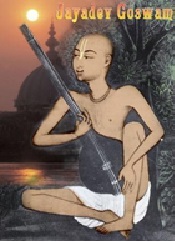 Srila Jayadev Goswami
Srila Prabhupada wrote,“Srila Jayadev Goswami appeared in Kendubilvavillage in West Bengal’s Birbhum district in the 11th or 12th century. In the opinion of some authorities, however, he was born in Orissa, and still others say that he was born in southern India” in his books.
At that time King Laxman Sen’s kingdom was in Navadweepa. The village Kendubilva is situated near the Ajay River. He received his deities of Shri Shri Radha Madhav from the river and used to worship it. These deities of Shri Shri Radha Madhav are now present in Kanak Vrindavan area of Jaipur. Srila Jayadev Goswami’s father was Bhoj Dev and his mother was Vama Devi.
Objective 3: To understand the reason behind Srila Jayadev Goswami’s marriage
There used to be a Brahmana in Jagannath Puri and that Brahmana was not having any child. So, for a long time, many years, he prayed to Lord Jagannath for a child. Lord Jagannath blessed him and they had a daughter named Padmavati. The daughter grew up, and when she became eligible for marriage, the Brahmana brought his daughter to Lord Jagannath and said “Jagannathji, I have dedicated this daughter to your feet, I want to get her married”. So Jagannath ji again came to him in his dream and told him “go to Navadweepa. My devotee Jayadev Goswami is there and he always chants the names of Hari, he is a very detached Vaishnav. You get her married to him”.
Then the Brahmana came to Sri Jayadev Goswami with his daughter and Sri Jayadev Goswami understood why he had come. Jayadev Goswami clearly refused saying that he had no interest in marriage. Hearing this, the Brahmana became very sad. Then the Brahmana said, “okay if I cannot marry her to you then I will not take my daughter back with me”. So the Brahmana left his daughter there and after that his daughter said, “Oh Vaishnav Thakur, if you do not accept me, then I will give up my life right here. You are my Lord, my master. I have accepted you in my heart. I cannot accept any other man”. So Jayadev Goswami got very worried and thus decided to marry Padmavati.
Objective 4: To Know where and when Jayadeva wrote his poem “Dasha-avatara-stotra”.
Some time after his marriage, Jayadeva and his wife Padmavati came to Navadweepa, where they built a small hut on the bank of Ballal dighi (not far from the present day ISKCON Mayapur-chandrodaya-mandir). Here Jayadeva wrote his poem “Dasha-avatara-stotra”. We sing one of those hymns every day when we praise Lord Narasimha in the morning.
tava kara-kamala-vare nakham adbhuta-śṛńgaḿ
dalita-hiraṇyakaśipu-tanu-bhṛńgam
keśava dhṛta-narahari-rūpa jaya jagadīśa hare
Objective 5: To know about how Srila Jayadev Goswami met King Lakshman Sen and what situation made him to stay in Champahati
Govardhan Acharya was a minister in the kingdom of King Laxman Sen. When Govardhan Acharya read this Dashavatara stotra, he was very impressed. He said “I should show this Dashavatara stotra to the king. The king will be very happy after reading it”. So Govardhan Acharya took this stotram to him and showed it to him. The king was very happy. He was impressed and asked “who has written this. I want to see this Vaishnava”. Then Govardhan Acharya replied “Jayadev Goswami has written this Dashavatara stotra. He does not meet any one, any king, any person with special status”.
Then the king said, “Okay, I will go in disguise. But I will definitely meet him”. He came once in disguise and was very impressed after seeing Sri Jayadeva Goswami. He prostrated himself before him like a humble Vaishnava and bowed his head before him. Jayadev Goswami welcomed him with great respect and honoured him. From his words it became clear that this is King Lakshman Sen.
The King invited him and said “you come and become the poet of our kingdom, become the court poet”. Then Jayadeva Goswami said “it is okay if you are forcing me to become your court poet. If I become a poet then I will not stay here in Navadvipa. I will go from here to Jagannath Puri, but I cannot come to you”. The king thought that Jayadev Goswami was a very detached Vaishnav. Then he said “there is a very beautiful place in Champahati, there are Champak trees all around, you will like it a lot. You will be able to do your bhajan very well there”. So in this way, the king is praying again and again. Then Jayadeva Goswami accepts this proposal and starts living in ChampaHati in Navadvipa.
Note: Champakahatta (Champahati) – “the market of champaka flowers.”
Objective 6 : To know about who wrote the very popular book “Gita Govinda” and what was the Leela performed by Lord Krishna while he was writing the book “Gita Govinda”
Jayadeva Goswami started writing Gita Govinda in ChampaHati. So when he was writing Gita Govinda, he was remembering the leela that Radha Rani was waiting for Krishna and Krishna was delayed. Radharani became very angry and started expressing her pride and refused to meet him or talk to him. So when Radharani expresses her pride, it becomes very difficult for Krishna to break that pride despite Krishna being the Supreme Lord. So, what did Krishna do to break the maan (anger with pride)? He took Radha’s feet and wore them on his head. Sri Jayadeva Goswami stopped after writing the first line in which he wrote ‘smara garala khandanam’. He wrote only this much, after that he stopped, his hands started shaking and he could not write further.
Sri Jayadeva Goswami thought, “what am I writing? All the powers are manifested in the Almighty Lord Shri Krishna and Radharani is his antaranga shakti; she is his eternal servant. How is it possible that the Supreme Lord Shri Krishna will wear the feet of Radha Rani on his head? Is this possible? He put down the pen and went to take a bath.Then the Supreme Lord Sri Krishna himself arrived at his house assuming the guise of Sri Jayadeva Goswami and went inside the room and completed that line ‘smara garala khandanam mama sirasi mandanam dehi pada pallavam udaram’
Padmavati got the opportunity to serve prasadam to Lord Krishna who was in the guise of Sri Jayadev Goswami. He took the prasadam and left. After some time, the original Sri Jayadev Goswami came back after finishing his bath. He saw Padmavati eating and said “What are you doing? Today I am seeing Padmavati, where you are taking the prasadam before me. What is the reason? Is your health fine?”
Padmavati said “you went to take a bath and came back very soon, asked me to serve you lunch and went out again. I am not able to understand what is happening”. So Jayadev Goswami went inside and he saw Gita govinda. He could see the complete line in it. Jayadev Goswami understood immediately that Madhava, Krishna himself had come here and had completed this line. He called Padmavati, “see what a miracle has happened. Do you know that Madhava himself came and completed the line by adding ‘dehi pada pallavam udaram’,? He certified that what I have written is correct and you are very fortunate. You fed Prasad with your own hands to Madhava. I did not get this good fortune”.
So in this way Jayadev Goswami wrote the book Gita Govinda, which is very popular. Even today in Jagannath Puri, Jagganath ji hears Gita Govinda everyday and likes it very much. Jayadeva Goswami also composed a book named Candraloka.
Objective 7: To understand how Lord Krishna revealed His form of Gauranga to to Jayadeva and his wife.
Lord Krishna appeared there to Jayadeva and his wife. Changing his colour to that of the golden champa tree which grew in the area, He revealed His form of Gauranga. He told them He would soon appear in Navadvipa to perform congregational chanting before taking sanyasa and going to Puri, He would relish Jayadeva’s Gita-govinda. Lord Chaitanya asked them to go to Puri.
Bhaktivinoda Thakura has commented that even though Shri Gauranga Deva hadn’t revealed his internal pastimes at that time, within the heart of Shri Jayadeva, Shri Bilvamangala, Shri Chandidas, and Shri Vidyapati, the transcendental mood of Mahaprabhu was already awakened even before He Himself actually made His appearance.
Objective 8: To know when was Jayadeva’s disappearance day.
His disappearance day is on Pausa Sankranti (January 15).
His worshipable Deities, Shri Shri Radha-Madhava, are being worshipped in the former temple of Radha-Govinda just outside the present city of Jaipur.
Objective 9: To know why Radha Madhav Temple at Kanak Vrindavan is also called Old Govind Devji Temple
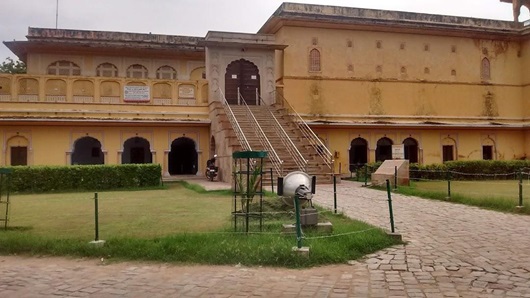
As per the popular opinion, the deity of Lord Govind Dev Ji was hidden at Radha Madhav Temple in 1714 AD before moving it into the existing Govind Devji Temple. Hence, Radha Madhav Temple at Kanak Vrindavan is also called Old Govind Devji Temple in Jaipur.
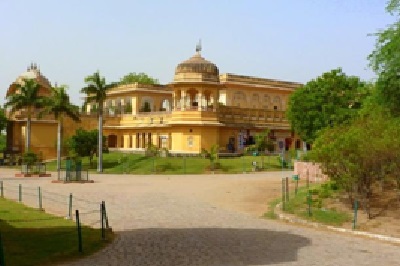 Old Govind Devji temple,
Radha Madhav Ji at Kanak Ghati, Jaipur
Objective 10: To understand about Radha Madhav Temple in Jaipur, its features and its location.
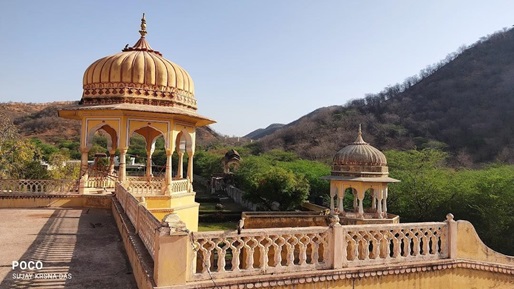
Radha Madhav Temple is the biggest temple in Kanak Vrindavan Garden complex in Kanak Ghati, Jaipur.
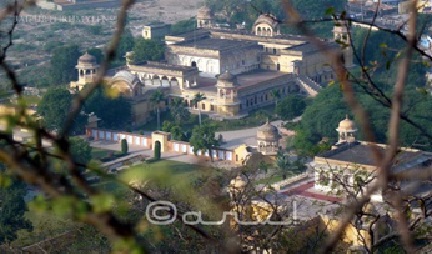 Radha Madhav Temple in Kanak Vrindavan Garden
complex in Kanak Ghati, Jaipur
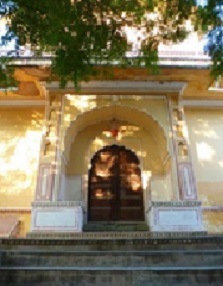 The original entrance gate at
Radha Madhav Temple
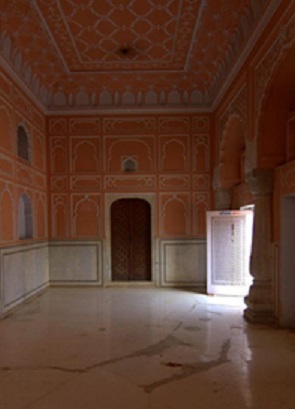
Captivating interiors with Araish work. Radha Madhav Temple/ Old Govind Devji Temple, Kanak Ghati, Jaipur
The temple has an unpretentious Rajput Haveli architectural style; it is beautiful. There is no spire, a feature found in Indian temples. The floor is made of an ancient plaster technique called Araish which simulates the mirror finish of white marble.
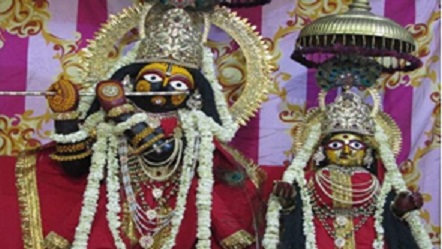 Radha Madhav Temple, Kanak Vrindavan,
Jaipur
The surrounding area is a valley and is called Kanak Ghati.
Govind Devji Temple Trust manages both temples in Kanak Vrindavan Garden complex – Natwarji Temple and Radha Madhav Temple.
Objective 11: To know about the timing of Kanak Vrindavan Temple at Kanak Ghati
Since Govind Devji Temple trust manages both Radha Madhav Ji and Natwar Ji Temple, these temples follow the Govind Dev Ji temple time schedule for Darshan/ Jhanki and Aarti. Do check the Govind Devji Temple Darshan timing online. The temple is open throughout the day. You can have Darshan during any of the 7 prescribed time slots in a day.
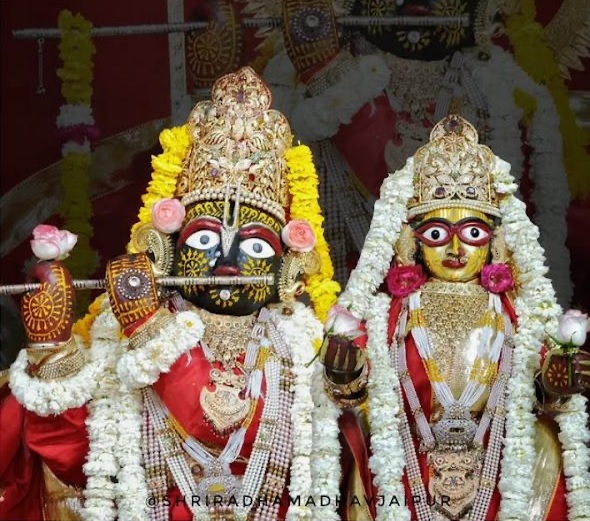
Objective 12: To know the the other deities housed in the Shri Radha Madhav Mandir in Jaipur
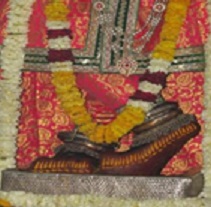
It houses several deities, with the primary ones being Shri Krishna and Shri Radha Rani. The temple features three sub-temples, with the main one containing a stone deity of Lord Krishna and a brass deity of Radha Rani. Additionally, there are statues of Hans Gopal, Sanak, and other sages, as well as a white stone statue of Lord Krishna holding Giriraj Mountain. The temple also houses utsava deities of Anand Behariji, a miniature form of Radha Madhavji.
Objective 13: To understand what one attains when he is actually taking part in Lord Caitanya’s saṅkīrtana activities
 gaura-prema-rasārṇave, śe taraṅge jebā ḍube,
se rādhā-mādhava-antaraṅga
gṛhe bā vanete thāke, hā gaurāṅga’ bo’le ḍāke,
narottama māge tāra saṅga
Anyone who takes pleasure sporting within the waves of the ocean of Lord Caitanya’s distribution of love of God immediately becomes a confidential devotee of Śrī Śrī Rādhā-Mādhava. It doesn’t matter whether such a devotee is in the renounced order of life or whether he is a householder. If he is actually taking part in Lord Caitanya’s saṅkīrtana activities and actually understanding what it is, then such a person is always liberated. Narottama dāsa aspires for his association.
(Verse 4 of Gaurangera duti pada by Sri Narottama dasa Thakura)
