
நோக்கங்கள்:
Objective 4: To learn about the major festivals celebrated at the Gopinatha temple.
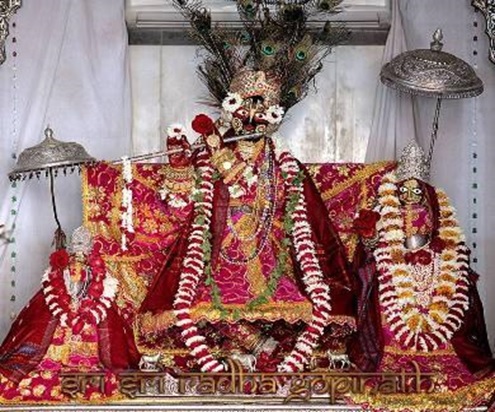
 Sri Sri Radha Gopinath, Ananga Manjari (to the leftof Gopinath) with Lalita and Visakha
Objective 1: To know the historical journey of the Gopinatha Deity from its original installation by Vajranabha to its present worship in Jaipur.
Vajranabha, the great-grandson of Krishna, originally installed Gopinathji in Vrindavana. When Aurangazeb raided Vrindavana in 1670, the original Gopinatha Deity was taken to Jaipur. The Gopinatha Deity in Jaipur is said to exactly resemble Lord Krishna, from the shoulders down to the waist.
The Deity of Gopinatha was discovered at Vamsi-vata by Paramananda Bhattacharya, who entrusted the Deity’s worship to Madhu Pandita. On the altar in this temple are Deities of Gopinatha, Srimati Radharani and Her sister, Ananga Manjari.
Objective 2: To know the divine pastime of Srimati Jahnava Devi’s disappearance at the Radha Gopinatha Temple and her eternal identity as Ananga Manjari.
There is a story about this temple that Srimati Jahnava Devi, the wife of Lord Nityananda, came to Vrindavana, and she came to the evening aratis at the Radha Gopinatha Temple. Suddenly, Gopinatha jumped off the altar and took Jahnava Devi onto the altar and closed the curtains. When the assembled Vaishnavas opened the curtain, Jahnava Devi was gone and Gopinatha was standing on the altar.
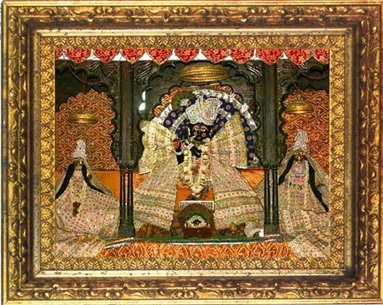
Later the deity of Ananga Manjari, the younger sister of Srimati Radharani was installed on the altar here. Jahnava Devi is Ananga Manjari in Krishna’s pastimes. Normally Srimati Radharani is to the left of Sri Krishna. In this temple Srimati Radharani is to the right of Krishna, and Ananga Manjari is placed on the left. Deities of Lalita and Visakha are also on the altar, along with a Deity of Lord Caitanya.
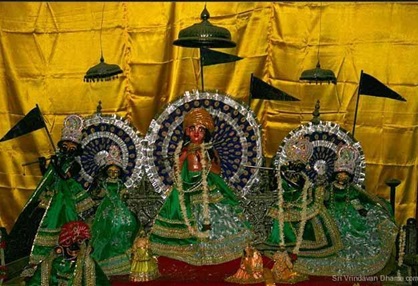 Gouranga with Radha Krishna on the Altar of the Old Temple
Objective 3: To understand the impact of Mughal invasions under Aurangzeb on the Gopinatha temple and its reconstruction in later years.
Sri Rayasila Shekhawat, who was given a large amount of land by Akbar for defeating the Afghans, built the original Gopinatha temple. This temple was built before the Govindaji and Madana-Mohan temples. This temple was broken and defiled by Aurangzeb’s soldiers. SriNanda Kumar Bose of Bengal constructed a new temple for Gopinatha.
Objective 4: To learn about the major festivals celebrated at the Gopinatha temple.
Some special festivals at this temple are Jahnava Utsava, which celebrates the appearance of Jahnava Devi, and Ban Behar Besh. Ban Behar Besh is celebrated on the next day of Jhulan Utsava. Jhulan Utsava continues from the third day of the bright moon, till the full moon Purnima in the month of Sravana (July-Aug).
Objective 5: To know the historical journey of the Radha-Gopinathji Deities from Vrindavana to Jaipur during the reign of Aurangzeb.
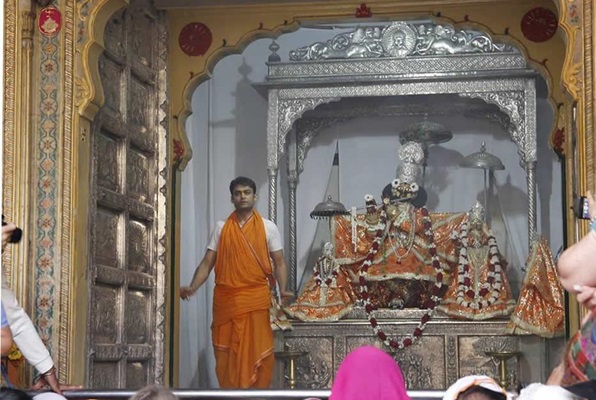
In 1669 A.D., during Aurangzeb’s reign, the Divine Holy Images of Radha-Gopinathji were first moved from Kama to Madhovilas, Jaipur, in 1775. In 1792, before his death, Deewan Shri Khushali Ram Bohra consecrated these images in his Haveli at Purani Basti, Jaipur, dedicating it as the Temple of Shri Gopinathji Maharaj. This Haveli became the nucleus of divine faith, and since then, Lord Gopinathji Maharaj has blessed Jaipur with His presence. For nearly a century, Lord Gopinathji resided in Kama (Kam-Van) in Bharatpur, Rajasthan, where he is revered as the Lord of Kam-Van.
| Event / Description | Time Period |
|---|---|
| King Kamsa strikes the six sons of Devaki and Yashoda’s female child (Yogmaya). Lord Krishna incarnates and later returns to Vaikuntha. Bajranabh, Krishna’s great-grandson, creates the image of Lord Gopinath, leading to the gradual disappearance of this heritage. | Dwapar Yug |
| Chaitanya Mahaprabhu discovers Vrindavan Dham → then Madhu Pandit (and others) arrive in Vrindavan on Mahaprabhu’s request. | Early 1500s – Kaliyuga (After the year 1502) |
| Manifestation of Radha-Gopinath at Vamsi-vata by Paramananda Bhattacharya, who entrusted the Deity’s worship to Madhu Pandita. | Around or after the year 1503 |
| Construction of Red Stone Temple near Nidhi-Van by Raja Raayasal Darbari of Shekhavat clan. | Around or after the year 1573 |
| Stay of Lord Radha-Gopinath in Vrindavan. | Till year 1669 |
| Stay of Thakur at Radha Kund and Kama (Kamvan). | From 1669 till 1775 |
| Arrival in Jaipur. | Savan Budi 13, Saturday, year 1775 |
| Stay at Madho Vilas, Jaipur. | Till 1792 |
| Arrival at the Present Temple Premises and continued stay thereafter. | Kartik Shukla 6, Thursday, year 1792 |
The famous sacred robe made of Tulsi mankas ( )of the year samvat 1602 which Shri Madhu Pandit use to wear also came to Jaipur and is on display at the present temple premises.
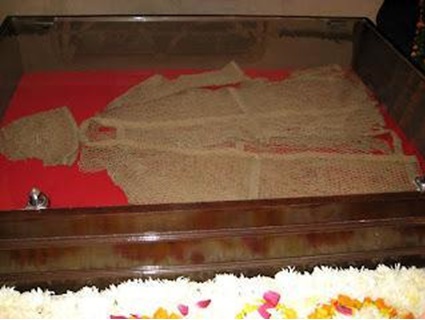 Madhu Pandita coat in Jaipur:
Objective 6: To understand the system of Ashta-yam Sewa and its significance in the daily worship practices at the Govind Devji Maharaj temple.
Sewa Paddatiகோ
Mandir Govind Devji Maharaj is a Madhaviya Gaudiya Sampradaya Temple. Madhaviya Gaudiya Sampradaya has its origin in Bengal and was founded by Lord Chaitanya Mahaprabhu. All the Temples & Devotional Centres of this Sampradaya follow the rituals, principles & system laid down in the scriptures such as :
1. Hari Bhakti Vilasa, written by Shrimad Santana Goswami
2. Purohit Darpana, compiled by Pandit Surendra Mohan Bhattacharya
The established routine system of Sewa is known as ‘Ashta-yam Sewa’ in which Nine Jhankis are opened daily for the public. There are set Hymns (Hktu & dhrZu) for each Jhanki linked to the theme & emotions inherent to that Jhanki. These are either in Hindi or in Bengali.
Objective 7: To learn about the life and devotion of Madhu Pandit, his connection to Gadadhara Pandit, and his discovery and lifelong worship of Radha Gopinath.
There are two different accounts of the re-appearance of Shri Gopinath who was first worshipped at Vamsi Vata in Vrindavan 500 years ago. According to one of them, in a vision Lord Krishna appeared before Paramananda Bhattacharya and instructed him to dig his deity out from a mound of earth in Vamsi Vata.
The other version says it was Madhu Pandit who unearthed the deity when he dug up the earth adjacent to ancient Vamsi Vata to plant a branch from the old dying tree, so it would not disappear altogether.
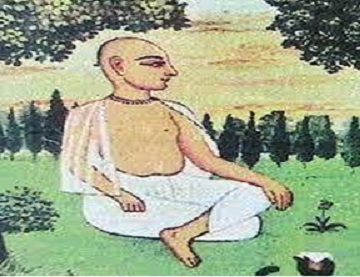
Madhu Pandit is largely credited with re-discovering and installing the Radha Gopinath deity. Madhu Pandit was a disciple of Gadadhar Pandit in Navadweep and had gone to Vrindavan to “find Krishna” or die trying. Madhu Pandit worshipped the deity for 40 years in his modest hut.
Many years later Raja Raesaal Shekhawat (Rae Shilji) of Jaipur arranged for the construction of the present red sandstone temple for Him, sometime after Emperor Akbar’s visit to Braj Vrindavan in 1573 AD.
Madhu Pandita arranged to have this temple built. Paramananda Bhattacarya and Madhu Pandita were disciples of Gadadhara Pandita, one of the most intimate devotees of Lord Chaitanya.
Madhu Pandita would read Srimad Bhagavatam every day. Madhu Pandit Goswami blessed Srinivas Acharya with Sri Gopinath’s garland just before Srinivas, Narottama, and Shyamananda departed Vrindavan for Bengal, with a bullock cart containing all the Goswami granthas.
Madhu Pandit Goswami serves as Mandali-sakhi in the group of Champakalata-sakhi in the nitya leela in Goloka Dham.
Objective 8: To know the unique tradition of Sri Gopinath wearing a wristwatch for over 40 years at the Jaipur temple.
Sri Radha Gopinath’s Miracles
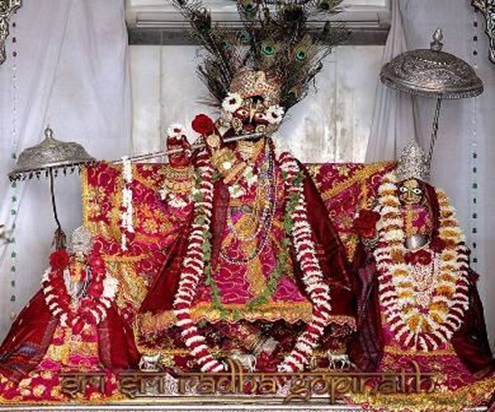
The Only Deity to Wear A Watch
One of the distinctive features of Sri Gopinath is that He has been wearing a wrist-watch for the past 40 years. Per local legend, once an Englishman in Jaipur visited the temple and was told that the deity is a living one and that He feels heat, cold, hunger and thirst. The Englishman smirked and gave his wristwatch for the deity to wear, saying it only worked on the pulse beat of a person and he wanted to verify the information that Gopinath ji was a living deity. The watch was put on the Lords left hand. Lo and Behold! To his utter shock, the watch started ticking! Gopinath did not return the watch. To this day, more than 50 years since, the watch functions perfectly and only stops when it is removed in order to change the Lord’s clothes. When the watch is strapped back on Gopinath ji’s wrist, it starts ticking.
Objective 9: To know the three stages of spiritual advancement according to Vedic principles: sambandha (relationship), abhidheya (practice), and prayojana (ultimate goal).
According to the Vedic principles, there are three stages of spiritual advancement, namely, sambandha, abhidheya and prayojana.
Sambandha refers to establishing one’s original relationship with the Supreme Personality of Godhead. Abhidheya refers to acting according to that constitutional relationship, and prayojana is the ultimate goal of life, which is to develop love of Godhead (premā pum-artho mahān).
If one adheres to the regulative principles under the order of the spiritual master, he very easily achieves the ultimate goal of his life. A person who is addicted to the chanting of the Hare Kṛṣṇa mantra very easily gets the opportunity to serve the Supreme Personality of Godhead directly. ( CC Adi 7.73P).
“Sri Govindaji acts exactly like the siksa-guru (instructing spiritual master) by teaching Arjuna the Bhagavad-gītā.. He is the original preceptor, for Govindaji gives us instructions and an opportunity to serve Him.
The diksa-guru is a personal manifestation of the Sri Madana-mohana vigraha.
Srila Gopinatha is the ultimate attraction of spiritual realization.” (CC Adi 1.47p.)
Prayojana
Objective 10: To describe the role of Srila Raghunatha Dasa Goswami as the prayojana acharya guiding devotees toward pure love of Krishna (prema).
Sri Raghunatha Dasa Goswami is our prayojana acharya. The Gopinatha Deity is Krishna as master and proprietor of the gopis, the totally surrendered devotees. The Gopinatha deity represents the prayojana-tattva (truth about life’s ultimate goal – pure love of Krishna). Srila Raghunatha dasa Gosvami accepts the lotus feet of Srila Rupa Gosvami as his highest aspiration. He thus reveals the way to attain the perfection of one’s loving relationship with Sri Krishna. Through humble prayers and service to the Radha-Gopinatha Deity, and by imbibing the teachings and mercy of Srila Raghunatha dasa Gosvami, a devotee can quickly advance in devotional service and ultimately attain the goal of life, prema-bhakti.
“The Gaudiya Vaisnavas who follow strictly in the line of Sri Caitanya Mahaprabhu worship the Divinity by chanting transcendental sounds meant to develop a sense of one’s transcendental relationship with the Supreme Lord (sambandha), and reciprocation of mellows of mutual affection (abhidheya), and ultimately, the achievement of the desired success in loving service (prayojana). These three Deities (Madana-mohana, Govindaji, Gopinatha) are worshiped in three different stages of one’s development. The followers of Sri Caitanya Mahaprabhu scrupulously follow these principles of approach.” (CC Adi 1.19p.
On Prayojana:
“prema-dhana vinā vyartha daridra jīvana
‘dāsa’ kari’ vetana more deha prema-dhana”
“Without love of Godhead, My life is useless. Therefore I pray that You accept Me as Your servant and give Me the salary of ecstatic love of God.” (cc Adi .20.37)
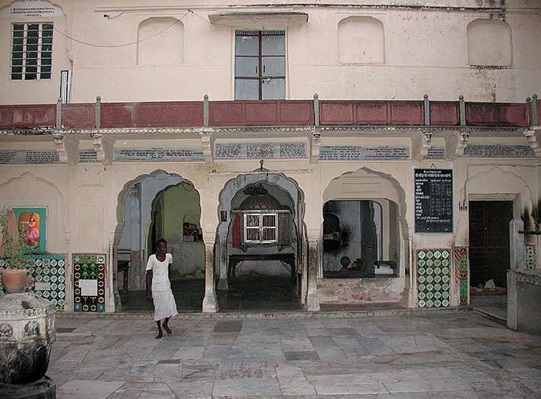
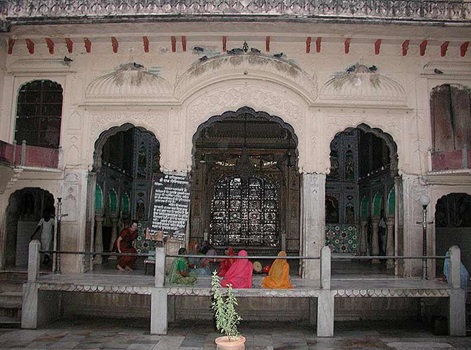
A unique embroidered tulasi-bead jacket and tulasi japa beads, both of which belonged to Madhu Pandit, are displayed in the courtyard.
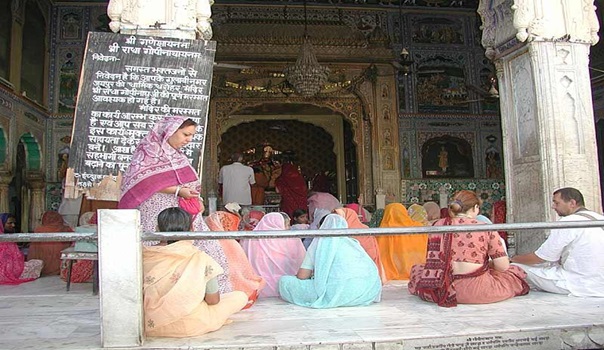
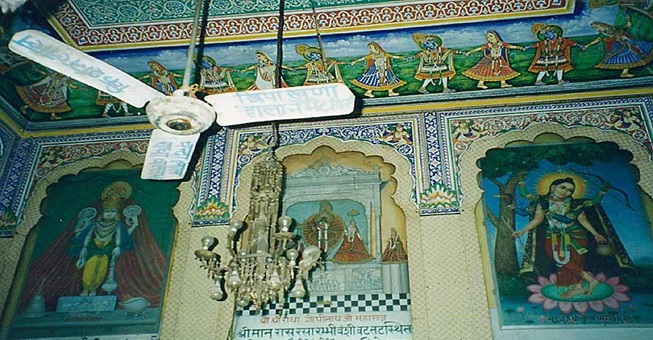
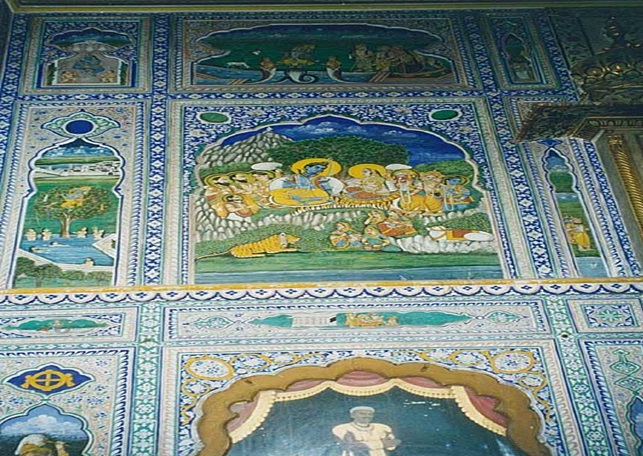 There are beautiful paintings on the walls. On the ceiling there are paintings of the rasa-lila.The temple is located in the Topkhanadesh area of Jaipur by Chandpol Bazaar.
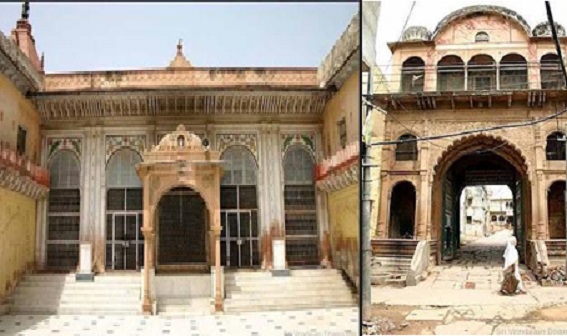 Temple Courtyad and Entrance to Gopinath Mandir from the street
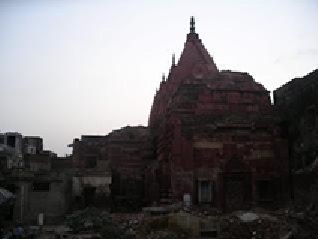
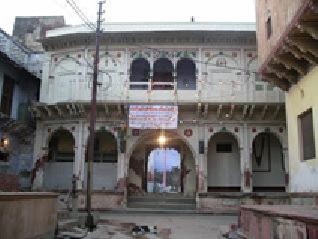 New temple entrance
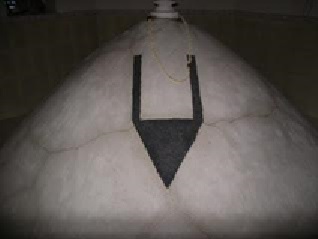 Samadhi of Madhu Pandit Goswami
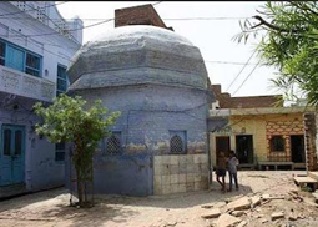 The Samadhi of Madhu Pandit
