
Objectives :
Objective 1: To learn about the origin and significance of the Madana-Mohana Deity.
Objective 2: To understand the divine history of the deity.
Objective 5: To learn about the deity relocating to Karauli
Objective 1: To learn about the origin and significance of the Madana-Mohana Deity.
Prayer by Srila Krsnadasa Kaviraj:
“Glory to the all-merciful Radha and Madana-Mohana! I am lame and ill advised, yet They are my directors and Their lotus feet are everything to me.” (Caitanya Caritamrita Adi 1.15)
HISTORY OF THE MADANA-Mohana Deity:
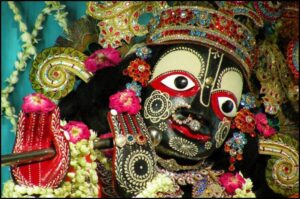
The Deity of Madana-Mohana was originally known as Madana Gopal. Madana-Mohana means “one who can even enchant Cupid.” The Deity of Madana-Mohan was made for Krisna’s great grandson Vajranabha and for many years it was lost.
Sri Advaita Acharya discovered the original Deity of Madana-Mohana at the base of an old vata tree, when he visited Vrindavana. He found this Deity at Advaita Vata, which is the place where he did his bhajana. This place is just below the hill on which the Madana-Mohana temple is located.
He entrusted the worship of Madana-Mohana to his disciple, Purushottama Chaube, who then gave the Deity to Sanatana Gosvami. Worshiped along with Madana-Mohana are Radharani and Lalita, who were sent to Vrindavana by Purushottama Jana, the son of Maharaja Prataparudra. Krishna Dasa took care of worshiping Madana-Mohan after Sanatana Gosvami left his body.
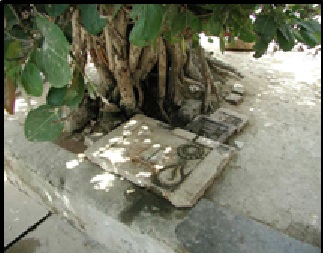 Sri Advaita Vata, Vrindavana – Place where Sri Advaita Prabhu
discovered Madan Mohan
The original Madana-Mohana Deity was moved from Vrindavana to Jaipur, when the Mughal Emperor, Aurangzeb, had his soldiers attack Vrindavana in 1670. The original Deity of Madana-Mohana is said to exactly resemble Krishna from the waist down. This deity is now in Karoli, which is southeast of Jaipur in Rajasthan. The Deity was moved from Jaipur to Karoli, at the request of a Jaipur Princess, who had married a prince from Karoli. Raja Gopala Sinha (who reigned from 1725-1759) built a temple for Madana-Mohana in Karoli, after receiving the Deity from his brother in law, the king of Jaipur.
In the sixteenth century, Sri Chaitanya’s immediate followers the Six Goswamis of Vrindavan established the earliest and most important deities in the Gaudiya tradition: Sri Madana Mohana represents sambandha (relationship), Sri Govindaji represents abhidheya (the path), and Sri Gopinatha represents prayojana (the goal). The Chaitanya-charitamrita (Adi 1.19) says, “These three Deities of Vrindavana have absorbed the heart and soul of the Gaudiya Vaishnavas.” They are the most special of all manifestations of Krishna, and merely seeing Them provides all-auspiciousness.
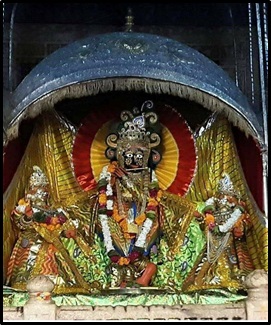 Original murtis of Radha(right),Krishna (at center),
Lalita gopi(left) in Shri Radha Madan Mohana Temple, Karauli.
Objective 2: To understand the divine history of the deity.
Story of the Deity:
Sanatana Gosvami would go daily to Mathura to beg each day one chapati from each house that he went to. Sanatana Gosvami had a dream in which Madana-Mohana told him that He was living in the house of a brahmana in Mathura and that he should come there to beg. The next day Sanatana went to the house of the brahmana and he saw Madana-Mohana playing with the brahmana’s children. The brahmana treated Madana-Mohana like one of his children. Retrieving prasada from the deity plate, before Sanatana’s eyes Chaube began to scold the deity just like his own child: “Why are You not finishing the food I am giving You?” This is the mood of vatsalya, parental love for the Lord. When Sanatana saw this, he chastised the brahmana and told him about the rules and regulation of how to serve the Deity.
Madana-Mohana then appeared to Sanatana Gosvami in a dream and told him that He was happy to live in the house of the brahmana as one of his children, but now that he had introduced so many rules and regulations he was not happy. Madana-Mohana also appeared to the brahmana and told him, you have so many sons, why don’t you give me to Sanatana Gosvami. The next day Sanatana went to see the brahmana and begged his forgiveness for chastising him. The brahmana then offered Madana-Mohana to Sanatana Gosvami. Sanatana said that he could not take Him, because he could not offer Him proper food offerings. Madana-Mohana told him that He would take whatever He was offered.
Each day “Anga Kadi” is offered to Madana-Mohana. Sanatana Gosvami would go to Mathura for begging. He used to get wheat flour and horse gram. He would mix the flour with water and make small balls, which he cooked. These balls were then offered to Madana-Mohana. Even now this food is offered to Madana-Mohana.
One day Sanatana was offering the usual dry chapatis to Madana-Mohana, and Madana-Mohana asked Sanatana for some salt. Sanatana was not against this, of course, but he was concerned about what the residents of Braja might say. “Why is a holy man asking us for a luxury like salt? Is he not renounced?” So, Sanatana replied, “Now you want salt and tomorrow You will want sweets. I have so much writing to do, please just accept these chapatis.”
Understanding this situation, Madana Mohana decided to use His mystical potency to remedy the situation. The very next day, the residents of Braja found a merchant’s boat stuck in a shallow part of the Yamuna River. By Krishna’s arrangement, it was filled with enough salt to satisfy Madana Mohana’s taste many times over.
Objective 3: To learn about the spiritual significance of the Radha Madana-Mohana Temple according to Srila Prabhupada’s teachings.
His Divine Grace A. C. Bhaktivedanta Swami Prabhupada confirms the importance of Madan-Mohan:
Srila Sanatana Goswami is the ideal spiritual master, for he delivers one the shelter of the lotus feet of Madanz-Mohana. Even though one may be unable to travel on the field of Vrindavana due to forgetfulness of his relationship with the Supreme Personality of Godhead, he can get adequate opportunity to stay in Vrindavan and derive all spiritual benefits by the mercy of Sanatan Goswami. This is also the special mercy of Madana-Mohana. In Chaitanya-charitamrita, Krishnadas first offers his obeisances to Madana-Mohana vigraha [Sanatana Goswami’s Deity], the Deity who can help us progress in Krishna consciousness.
Along with Madana-Mohana, Rupa Goswami’s Govindadev Deity and Madhu Pandit’s Gopinath Deity are the life and soul of the followers of Chaintanya Mahaprabhu. Madana-Mohana represents sambandha-tattva; Govindadev represents abhideya-tattva; and Gopinath represents prayojana-tattva.
As Srila Prabhupada says:
These three Deities have very specific qualities. Worship of Madana-Mohana is on the platform of reestablishing our forgotten relationship with the Supreme Personality of Godhead. In the beginning of our spiritual life we must worship Madana-Mohana so that He may attract us and nullify our attachment for material sense gratification. This relationship with Madana-Mohana is necessary for neophyte devotees. Then, when one wishes to render service to the Lord with strong attachment, one worships Govinda on the platform of transcendental service. When by the grace of Krishna and the other devotees one reaches perfection in devotional service, he can appreciate Krishna as Gopijana Vallabha [Gopinath], the pleasure Deity of the damsels of Vraja.
As the person who established the worship of Madana-Mohana, Sanatana Goswami occupies a special position in the disciplic succession of Chaitanya Mahaprabhu. He is the representative teacher of sambandha-gyana, or knowledge of our proper devotional relationship with Krishna.
Objective 4: To learn about relocating the deity to Jaipur, upholding sacred traditions and spiritual devotion.
Deity Moves to Jaipur
The deity’s journey outside of Braja involves a bit of history. While earlier Moghul emperors such as Akbar, Jahangir, and Shah Jahan showed no animosity toward the Vaishnavas in their domain – indeed, they often gave them land endowments as well as financial support – Aurangzeb’s rule was different, setting forth prohibitions, at best, and causing destruction, at worst. And so it was that in 1669 Aurangzeb infamously issued mandates to demolish all Hindu temples, and while there is today some question whether he was the sole tyrant involved in these mandates, many of them clearly occurred under his reign.
The main Vaishnava temples in Vrindavan and Mathura to suffer during this period were Radha–Madana-Mohana, Radha-Govinda, Radha-Gopinatha, Radha-Ballabha, Sri Govardhanatha, and Sri Keshava Deva (this last one in Mathura, at the Lord’s birthplace). All the deities were moved to safer areas. Most were relocated, step by step, to Radha-kunda, Kamyavan, and eventually Jaipur. This occurred in the eighteenth century.
The arrival of the Vrindavan deities in Jaipur is documented by royal court records of the period, stating that the deities first passed through the kingdom of Raja Badan Singh, the emperor of Kumher, in the Bharatpur district of Rajasthan, and finally arrived in Jaipur on Monday, the full-moon day of the month of Karttika (October/November) in 1742 CE. The king of Jaipur, we are told, viewed the deities in the courtyard of the area’s famous temple of Sri Sri Sita-Rama, and then They were brought to Badal Mahal, where They were to be established for all time. But this was not to be.
Objective 5: To learn about gracefully relocating the deity to Karauli, upholding sacred traditions and spiritual devotion.
Jaipur tradition asserts that Krishna Himself appeared to Raja Gopal Singh of Karauli, asking him to bring the deity of Madana Mohana, temporarily stationed in Jaipur, to his own kingdom. The king wanted Madana Mohana to reign over his court. Besides, Gopal Singh’s new bride, the daughter of Jaipur’s king, loved the deity with heart and soul, a love that matched his own.
Accordingly, Gopal Singh traveled to Jaipur and asked the Raja (the son of Jai Singh II), Madho Singh I, to allow him to move Madana Mohana to Karauli, claiming that Krishna Himself had requested it.
Madho Singh responded, “Your words are fine, but how can we know that Madana Mohana truly wants to go there? We will give you a test. If you pass the test, then Madana Mohana ji will travel with you to Karauli.”
Here was the test: Madho Singh covered Gopal Singh’s eyes with a strip of cloth, took him to the temple, and released him, saying, “Go and hold the deity. We have several forms of Krishna in this room, and if you touch Madana Mohana first, then we will ordain His going with you.”
By this time, a great crowd had gathered in the assembly hall. Everyone was curious to see if the king would be able to recognize Madana Mohana with his eyes covered. The whole family of Jaipur’s king was in attendance.
In the end, Gopal Singh correctly approached Madana Mohana’s alcove and stopped right before the deity. He felt and grasped the feet of his beloved Krishna. All the assembled princes and townspeople praised his love for the Lord. “Jaya Madana Mohana!” The king of Jaipur thus gave his permission for the deity to be taken.
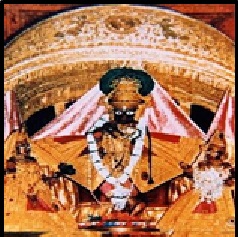
Madana Mohana was moved to Karauli, and He has been there ever since.
One further esoteric reason for His relocation that may serve as a backdrop for the above narrative: Tradition holds that the deities Govinda and Gopinatha came to appreciate the land of Jaipur, where Their worship was enhanced even beyond that of Vrindavan, but Madana Mohana, it is said, was engrossed in memory of Braja-mandala. Those acquainted with sacred geography will note that Karauli is in fact part of the Braja Charausi Kosha, an annual pilgrimage around the whole of Braja.
The pujaris at the Madana Mohana temple hold that King Gopal Singh had a dream in which Madana Mohana expressed His desire to return to Braja. But upon awakening, the king realized that Karauli is technically part of greater Braja-mandala, even though it exists within the borders of Rajasthan. Thus he felt confident and comfortable in worshiping his Lord in that part of India.
In Sanatana Gosvami’s Brihad-bhagavatamrita, Sanatana’s deity is among the main characters, though under the name Madana Gopala.
