
Objectives:
Objective 5: To understand the theological challenge posed by the Ramanandis.
Objective 1: To understand the historical context of Krishna temples during the transition from the Delhi Sultanate to the Mughal Empire
Historical Context: From Delhi Sultanate to Mughal Empire
The political landscape of Northern India underwent significant transformations over several centuries, impacting religious practices and kingdoms.
Delhi Sultanate (approx. 1192-1526 AD):
Governed by five major dynasties (Mamluk, Khilji, Tughlaq, Sayyid, Pashtun/Lodi) for over three centuries, this period marked the end of ruling regional Hindu kingdoms in Northern India.
Mughal Empire (1526 onwards):
Rose to power with Babur’s defeat of Ibrahim Lodi in the Battle of Panipat (1526). The Mughal Empire saw most of India fall under its sway.
Mughal Religious Policies:
While generally characterized by Hindu persecution, there were notable exceptions.
Akbar’s Tolerance:
Emperor Akbar (reigned 1556-1605) showed a degree of religious tolerance and even support for Hindu institutions. He endowed land grants for numerous temples in Mathurā, lifted the pilgrimage tax on Hindus in 1562, and repealed the jizya tax (a poll tax on non-Muslims) in 1564.
Jahangir’s Reign:
Continued the policy of facilitating land grants for temples, converting Todar Mal’s grant into a “permanent imperial grant” in 1632.
Aurangzeb’s Persecution:
In contrast, Aurangzeb (reigned 1658-1707) decreed that Hindu temples and carved images, or Deities, should be destroyed in 1669, leading to danger for Deities, priests and pilgrims.
Objective 2: To understand the role of Gaudiya Vaishnavas in reviving Krishna bhakti in Vrindavan and learn about their influence in securing royal patronage for temple construction and deity worship.
The Gaudiya Vaishnavas in Vrindavan and Their Patronage
The Gaudiya Vaishnava movement played a crucial role in revitalizing Vrindavan as a spiritual center.
Lord Chaitanya’s Mission (1512 onwards):
Lord Caitanya arrived in Mathura in 1512, identifying and locating places where Krishna had enjoyed pastimes. He tasked Rupa Gosvami and Sanatana Gosvami with reconstructing Vrndavana and rededicating it to Krishna.
Contributions of Rupa and Sanatana Gosvami:
They not only rebuilt the sacred places of Krishna’s life but also wrote books that presented Lord Caitanya’s doctrine.
Jiva Gosvami’s Pivotal Role:
Their nephew, Jiva Gosvami, continued their work. He supervised the construction of magnificent temples for the worship of Krishna, wrote exhaustive philosophical treatises, and distributed religious manuscripts. Beyond theology, Jiva Gosvami was instrumental in procuring land and nominating custodians for temples, successfully petitioning ministers for imperial support, securing official recognition and land grants for important temples like Govindadeva and Madana-Mohana. His efforts were key to establishing Vrndavana as the principal seat of Vaishnavism in northern India.
Mughal Official Support: Todar Mal:
A Mughal minister and supporter of the Gaudiya Vaishnava school, he petitioned Akbar to provide official recognition for the custodians of important temples and arranged land grants for these temples, including 100 bighas of land for the Madana-Mohana temple in Vrindavana in 1584.
Man Singh:
A significant patron, he was involved in temple reconstruction (e.g., Jagannatha temple in Puri) and built the “far larger” Govindadev temple in Vrindavan.
Objective 3: To understand the significance of Govindadeva’s departure from Vrindavan and learn about the circumstances that led to the deity’s relocation for preservation during times of threat.
The Departure of Govindadev from Vrindavan
Aurangzeb’s decree of 1669 forced the migration of deities for their protection.
Threat to Deities:
Deities, priests, and pilgrims were in danger, leading to Vaishnava priests appealing to the Hindu dynasties of Rajasthan for protection.
Govinda’s Journey:
Govinda, a principal deity of Vrindavan, was secretly moved from his splendid seven-story temple to Radha-kunda, then to Kaman (a fortified city), and eventually to Amber.
Rajput Patronage:
The Rajput kings of Amber, while allied with the Mughals against the Jats, patronised the Vrndavana Deities, whom the Mughals wanted to destroy. Ram Singh, king of Amber, ordered Govinda’s transfer to Kaman in 1671, with the intention of a temporary stay. However, Govinda did not return to Vrndavana.
Objective 4: To understand the role of Maharaja Sawai Jaisingh II in establishing Govind Dev Ji Temple as a center of royal and religious legitimacy
Maharaja Sawai Jaisingh II and Religious Legitimation
Maharaja Sawai Jaisingh II’s reign (1699-1743) marked a period of significant religious and political developments.
Legitimation through Patronage:
Rulers like Jaisingh II extensively used religious patronage to legitimize their status, particularly as Hindu rulers. He supported diverse religious institutions, initiated reforms, and configured his state upon the pillars of ‘dharma’. This patronage included constructing mosques, indicating a broad approach.
Religious and Political Developments:
The 18th century saw tensions between state authority and certain religious groups. Jaisingh II aimed to inspire unity amongst the diverse sects within his domain, including Gauḍīya Vaiṣṇava, Nimbārka, Rāmānandī, and Vallabha traditions.
Jaisingh’s Reforms:
He issued orders regulating sadhus, prohibiting them from carrying guns or having illegitimate relations with women, and established a colony (Vairāgyapura) to provide land and shelter for sadhus instructed to marry.
Objective 5: To understand the theological challenge posed by the Ramanandis
The Challenge of the Ramanandis and the Rise of Baladeva Vidyabhushana
The arrival of Govindadeva in Amber challenged the established authority of the Ramanandis.
Ramanandi Hegemony:
The Ramanandi mahantas had enjoyed a privileged position in the Amber kingdom for generations, with Galta serving as their northern headquarters
Govinda’s Popularity:
Govinda’s arrival in Amber and His popularity with the royal family challenged the Ramanandi hegemony. Jaisingh II was “ultimately a devotee of Govinda,” and Govinda’s arrival was a high point in his personal spiritual quest.
Ramanandi Objections:
Unauthorized Lineage:
They claimed the Gaudiya lineage was an “unauthorised fifth lineage,” stating, “There are only four sampradayas (Śrī, Brahmā, Rudra, Kumāra), not five.”
Radha-Krishna Worship (Parakiya doctrine):
They objected to the worship of Radha and Krishna together because “They are not married,” viewing the parakīyā doctrine (Krishna’s relationships with married gopis) as immoral and inappropriate behavior for the divine. They argued that there is no precedent for Radha and Krishna being worshiped together!.
Neglect of Narayana Worship:
The Ramanandis were critical of the Gaudiyas for worshiping Krishna without first worshiping Narayana.
Jaisingh’s stance on Parakiya Lila:
Jaisingh II, while deeply devoted to Sri Sri Radha Govinda as the state deity, expressed apprehension towards the worship of Rādhā and Krishna’s extramarital affairs (parakīyā lila). He preferred the svakīyā lila (married relationship) as it appeared vital for a king endeavoring to instill morality amongst his ruled subjects.
Jaisingh’s Mandate:
To appease the Ramanandis, Jaisingh asked Gaudiyas to place the Deity of Radharani in a separate room, explain their neglecting Narayana worship, and prove their link with the Madhva sampradaya. He also commissioned the Gaudiya Vaishnava sect to provide a commentary on the Brahma-sūtras that would explicitly demonstrate an affiliation with an authorized lineage, specifically the Mādhva lineage.
Vishvanatha Chakravarti’s Role:
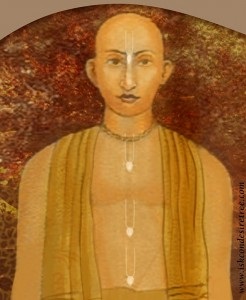
A respected Gaudiya vaishnava acharya, he explicitly advocated the parakīyā-vāda proposition without compromise. Upon being invited by Jaisingh, he deputed his student, Baladeva Vidyabhushana, to represent the Gaudiya sect in Jaipur, as he had vowed never to leave Vrindavan.
Objective 6: To learn about the spiritual evolution of Baladeva Vidyabhushana and understand the significance of his contribution in defending Gaudiya Vaishnava philosophy through the composition of the Govinda Bhashya.
He had learned Madhva acharya’s Vedanta-sutra commentary and was initiated into the Madhva sampradaya. Later, he studied Jiva Goswami’s Bhagavat Sandarbha and became convinced of the Gaudiya perspective, accepting Sri Caitanya Mahaprabhu as the Supreme Lord. He further studied under Vishvanatha Cakravarti in Vrindavan, learning the esoteric meaning of bhagavata philosophy. Vishvanatha leveraged Baladeva’s prior connection to the Mādhva tradition to establish the required lineage link.
The Debate and Baladeva’s Triumph:
Baladeva’s defense of the Gaudiya tradition in Jaisingh’s court was pivotal.
Baladeva’s Assertion of Madhva Link:
Confronted by the Ramanandis, Baladeva confidently stated, “I am from the Madhva-sampradaya. I have been initiated in Mysore.” He further presented Kavi Karnapura’s Gaura-ganoddesa-dipika as proof of the Gaudiya lineage from Madhva.
The Brahma-sutra (vedanta sutra) Commentary Challenge
The Ramanandis demanded a Gaudiya commentary on the Brahma-sutras, knowing the Gaudiyas typically accepted Srimad-Bhagavatam as their commentary. Baladeva, recognizing the need for a formal commentary to satisfy orthodox standards, declared he would write one, requesting “several days to write it”. He was given one month.
Divine Inspiration (Govinda-bhasya):
Baladeva prayed to Govinda for empowerment and wrote continuously for “seven days” (or “one month,” according to some accounts). The resulting commentary on brahma-sutra was named Govinda-bhasya.
Baladeva’s Arguments:
Lineage and Brahma-sutra:
He explained that Govinda-bhasya was based on Madhva’s commentary, but there are some important differences, upholding the Gaudiya philosophy taught by Lord Chaitanya. He asserted that Govinda had inspired this work.
Radha-Krishna Worship:
Addressing the objection to their unmarried status, Baladeva through his brahma-sutra commentary presented that “Radha is the eternal energy of Krishna and is never separated from Him. Their relationship may be parakiya or svakiya, but that does not affect the eternal nature of Their union”. He declared the separation of Radha and Govinda as artificial and therefore offensive to the Lord.
Narayana Worship: Jaisingh’s Verdict “Victorious Gopala”: : Legacy of Baladeva and Jaisingh Baladeva’s Continued Contributions: Srila Prabhupada’s dedication in his ‘Bhagavad-gita As It Is’ recognizes Baladeva Vidyabhushana “who presented so nicely the Govinda-bhāṣya commentary on Vedānta philosophy”. Objective 7: To understand Jaisingh II’s devotion to Govind Dev Ji and learn about his legacy in shaping Jaipur’s spiritual identity through royal patronage. Jaisingh’s Devotion and Legacy: Jai Singh later installed Govinda as the king of Jaipur and accepted the position of minister for himself. His royal seal reflected this devotion: “sri govindadeva carana savai jai singh sarana” – ‘Lord Govinda, at whose lotus feet Jai Singh takes refuge’. This demonstrated his ultimate legitimization not only of the Gaudiya Vaishnava tradition but also of his own rule through divine sanction.
He clarified using his brahma-sutra commentary that Narayana may be worshiped in any of His forms, including Krishna and that no scriptural injunction prohibits the worship of Govinda exclusive of Narayana.
After Baladeva’s eloquent and exhaustive presentation, the Ramanandis offered no rebuttal. King Jaisingh delivered his decisive judgment: “The evidence supporting the Gaudiya legitimacy is unassailable. Hereafter, the Gaudiyas shall be recognised and respected as an authorised religious sect. I order the reunion of Radha with Govinda”.
The Gaudiya mahantas built a “temple of victory” on a hill overlooking Galta Valley, naming the deity “Vijaya Gopala (‘Victorious Gopala)”.
The victory had lasting implications for the Gaudiya Vaishnava tradition and the patronage of Jaisingh.
He returned to Vrindavan, assumed leadership of the Gaudiya community, and continued to write, producing commentaries on Upanishads and works of the Vrindavan Gosvamis, as well as original works. He remained the unquestioned authority on Vaishnava theology until his death.
Satisfied with the synthesis of Vaishnava religions, Jaisingh dedicated himself to Govinda. He moved Govinda to the Jai Nivasa Gardens in 1714 and later built a temple for Him within the Jaipur palace compound in 1735.
