
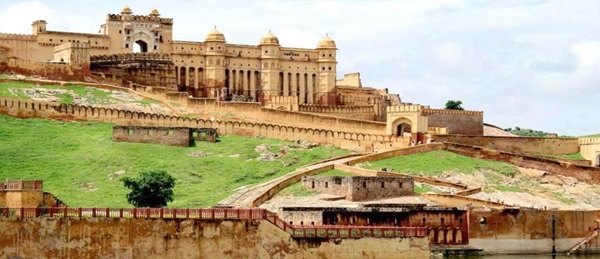
 A fort with bespoke architecture, Literally meaning the ‘Victory Fort’, it was built to protect Amer Fort and its huge palace complex from enemies of the state.
Objectives:
Objective 1: To understand the historical importance of Jaigarh Fort as a defensive structure built by Maharaja Jai Singh II in 1726 to protect Amer Fort
History of Jaigarh Fort
Jaigarh Fort in Jaipur was built by the ruling King Jai Singh II in the year 1726. With an expansive layout overlooking Amer Fort, the fort boasted of exuberance and royalty. It was built to be a defensive structure, rather than a palace itself, by the king. The highlight of the fort is the connecting underground pathway between Amer Fort and Jaigarh Fort to help people reach safety, in case of an attack.
The fort provides an excellent view of the Aravalli Range and Maota lake, and is actually built atop the Hill of Eagles, also known as Cheel ka Teela.
It is structurally and architecturally quite similar to Amer Fort.
It served as the residence of many kings and was also used to store weapons, artillery and ammunition of the Rajput rulers along with other military utilities.
It was said to be the main cannon foundry for the Mughal rulers. The cannon outpost was protected during the many consecutive wars that broke out in the Mughal dynasty in 1658, until the protector Dara Shikoh was beaten in battle and slain by his own brother Aurangzeb.
During the reign of the Mughal Emperor Shah Jahan, Jaigarh Fort came to be known as the world’s most efficient cannon foundry. It was mainly given this title because of the presence of massive iron ore mines located along the vicinity of the fort. The wind tunnel of the cannon foundry is said to suck in the hot air from outside and help in melting metal to build the cannons, with temperatures inside soaring as high as 2400 °F.
Objective 2: To understand the architectural intent behind Jaigarh Fort’s construction as a military fortification rather than a palace.
Architecture of Jaigarh Fort
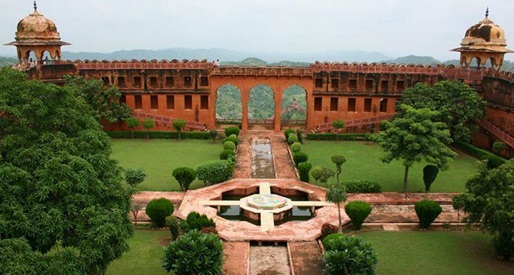
Jaigarh Fort was named after Raja Jai Singh II and was designed, conceptualized and intricately executed with perfection by the then architectural maestro, Vidyadhar. It was built to depict the rich culture and heritage of the city, which is visible even today. The enormous structure is a true reflection of a glorious era of kings and queens, bedecked with their royal attire and magnificence.
The fort is built with typical red sandstone that is the predominant material used in all, or most, Rajput and Mughal forts. Complete with thick walls and beautiful carvings, the entirety of the fort talks about the different phases of evolution that it has seen and still stands strong today.
This remarkable structure houses few of the most exquisite architectural gems such as Aram Mandir, Lalit Mandir, Laxmi Vilas and Vilas Mandir. The other two ancient temples Ram Harihar built in the 10th century and Kal Bhairav temple built in the 12th century, add to the attraction of the fort.
This magnificent fort is spread over 3 kilometres in length and a kilometre in width.
It houses the world’s biggest cannon on wheels known as ‘Jaivana’.
It is bounded by massive battlements and is known to be the strongest of the three forts in Jaipur. It never faced much resistance from the enemies and is famously known as the ‘Victory Fort’ because it was never conquered by anyone.
The fort, along with its multifarious attractions, still stand strong today and are a delight to a history buff, looking to explore the various chronicles of Rajput history
Objective 3: To know the fort’s fortified design, Persian-style gardens, latticed galleries, and stunning vantage points over the Aravalli hills and Maota Lake.
Other Features of the Jaigarh Fort
Fascinating interiors
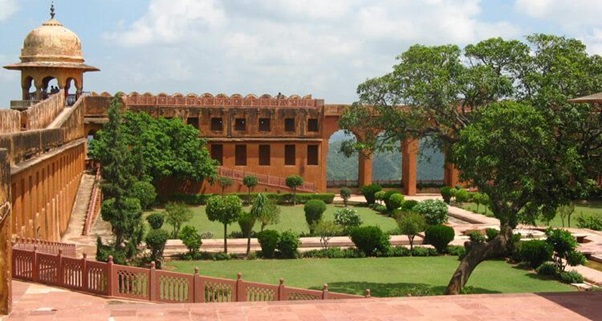
The palatial complex houses a beautifully tended square Persian-style garden that is rich in greenery and is surrounded by the thick red sandstone walls. One can take a walk in the garden by walking down the embankments surrounding the garden area.
Jaigarh fort is said to be impregnable because of its thick walls.
Visitors can see the carefully latticed windows covering the galleries and rooms, while a central watch tower overlooks the complete landscape surrounding it. Travellers can enter the Aram Mandir via the Awani Darwaza, a triple-arched entrance that boasts of intricate designs and figurines. It is also a great place to get a superb view of the Sagar Lake located close-by.
Another interesting fact is that you can get a mesmeric look of the exteriors from inside but nothing can be seen from outside.
Objective 4: To learn about the unique features of the fort’s Jaivana Cannon, museum collection & To showcase the armoury (Vijay Garh) that features historic weapons.
Things to do in Jaigarh Fort, Jaipur
Let the charm captivate you
Jaivana Cannon: Jaigarh Fort is home to the largest Cannon on Wheels, also known as the ‘Jaivana Cannon’. It was beautifully assembled during the reign of Sawai Jai Singh II. It was manufactured in 1720 and still stands strong within the fort premises.
The Jaivana was made during the reign of Maharaja Sawai Jai Singh II (1699–1743) at a foundry in Jaigarh. The barrel itself is 20.19 feet (6.15 m) in length and weighs 50 tonnes. It has a diameter of 11 inches (280 mm).
The barrel has embellishments carved on it which depict an elephant scroll, trees, and a pair of ducks or birds. It is perched on wheels and has the machinery of two back wheels mounted on roller pin bearings, to turn it 360° and fire in any direction. An aluminium-shed was erected to defend the cannon against weather extremities. The cannon had a range of around 10 kilometres and used 50 kilograms (110 lb) balls.
The northern portion of the complex houses the famous Aram Mandir and the Charbagh Garden built in gorgeous Persian-style.
Trivia: It was rumoured that there was treasure buried under the water tanks of the fort that was later discovered by the Rajasthan government in the ‘70’s. The truth behind this is still quite speculative.
Museum: The Fort houses a gorgeous museum depicting the lifestyle and period of Jaigarh fort. With stamps of the Royalty of Jaipur, along with other precious artefacts and photographs, puppets and other war utilities, it is said to give you a sneak-peak into the lives of the royals.
The museum also houses a spittoon belonging to the 15th century and a circular pack of cards. One can see a hand-drawn blueprint or image of the fort and the palace within the museum premises.
Armoury: The armoury chamber here has a wide display of shields, swords, guns, time bombs, camel-mounted guns, muskets and also a 50 kilograms (110 lb) cannonball. This place is called Vijay Garh.
The cannon was said to be test fired in the year 1720 by Maharaja Jai Singh II and was said to have landed 37 kilometres away at a place called ‘Chaksu’, creating a crater for a lake. The cannoneer was believed to have died before he could attempt to jump into the lake next to the cannon.
Pictures on display are old photographs of Jaipur’s Maharajas namely, Major General Man Singh II and Sawai Bhawani Singh, who served in the Indian Army as senior officers. It also has a gorgeous treasure lock with five keys in it.
The armoury also stores a lot of other weapons and military utility that is said to be a part of the Rajput and Mughal wars in the 18th century.
Other structures: The palace is said to house other notable architectural delights called Diwan-i-Aam, Khilbat Niwas, the highest point of the fort ‘Diya Burj’ and Shubhat Niwas.
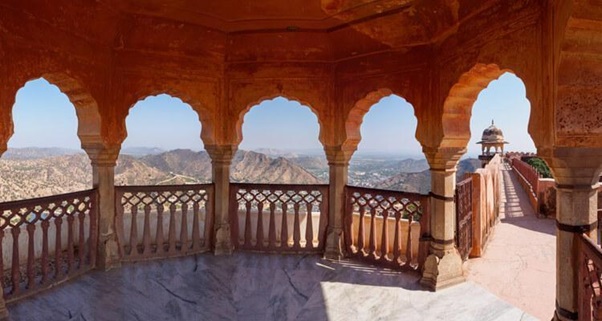
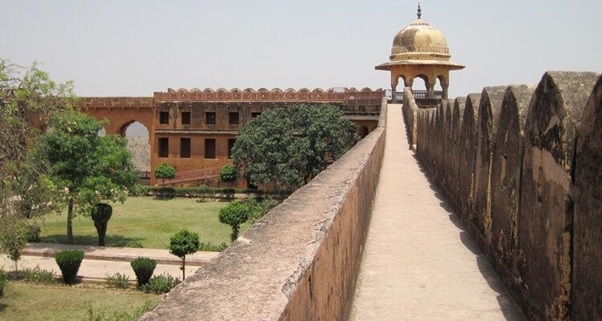
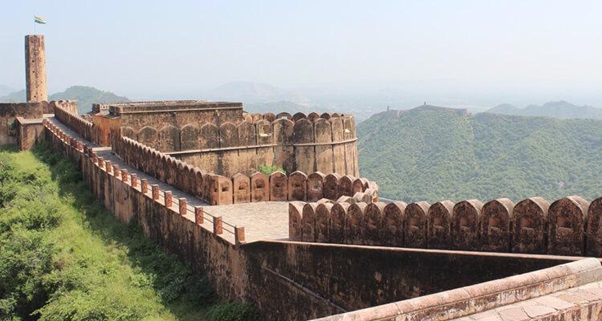
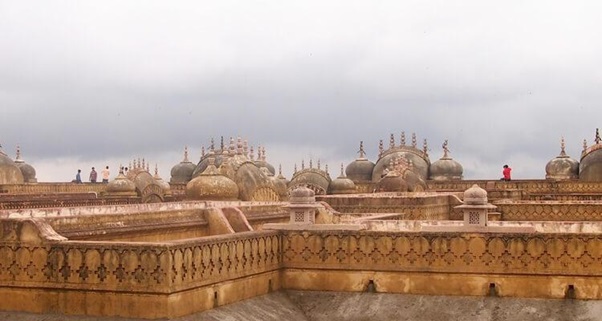
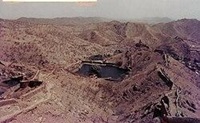 Left: Jaigarh Fort as seen from the Amer Fort.
Right: View of Aravalli Hills from Jaigarh Fort
