
Objectives :
Objective 1: To learn about the historical significance of the City Palace in Jaipur.
Objective 2: To understand the reason behind the shift of the royal court from Amber to Jaipur.
Objective 3: To know about the architectural style historical background of the City Palace.
Objective 5: To describe the significance of the main entrance gates of the City Palace.
Objective 7: To identify the deities and seasonal associations represented by each gate.
Objective 1: To learn about the historical significance of the City Palace in Jaipur.
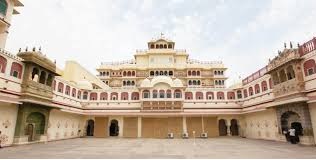
The City Palace in Jaipur is a magnificent royal residence and former administrative centre of the rulers of Jaipur. Constructed under the reign of Maharaja Sawai Jai Singh II, the palace’s history is deeply intertwined with the founding of Jaipur city in 1727.
Objective 2: To understand the reason behind the shift of the royal court from Amber to Jaipur.
Maharaja Jai Singh moved his court from Amber to Jaipur due to population growth and water scarcity, commissioning the palace soon after establishing the new city.
Jaipur remained the capital of the kingdom until 1949, when it became the capital of the present-day Indian state of Rajasthan. The City Palace functioned as both the ceremonial and administrative seat of the Maharaja of Jaipur and continues to house the royal family. Today, it is also home to the Maharaja Sawai Man Singh II Museum and hosts religious, cultural, and public events.
Objective 3: To know about the architectural style historical background of the City Palace.
The palace complex reflects the grandeur of Mughal and Rajput architectural styles and was built following the principles of Vastushastra. Vidyadhar Bhattacharya, a Bengali architect from Naihati, played a key role in designing the city and palace. The royal family, including Rajamata Padmini Devi and Princess Diya Kumari, actively manage the palace, museum, schools, and charitable initiatives aimed at empowering underprivileged women in Rajasthan.
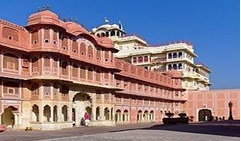 Front elevation of City Palace
Historical Background:
The palace lies in the heart of Jaipur, to the northeast of the city centre. Built on a plain surrounded by hills, the City Palace originated on the site of a royal hunting lodge. Maharaja Sawai Jai Singh II, who ruled from 1699 to 1744, initiated construction by building the palace’s outer walls.
Amber, located 11 km from Jaipur, was the previous capital of the kingdom. Jai Singh’s decision to shift the capital was driven by population pressure and water shortages. Jaipur was meticulously planned in six blocks, separated by wide avenues, and designed according to Vastushastra principles.
The 18th century saw conflicts among Rajput rulers, but Jaipur maintained cordial relations with the British. During the 1857 Sepoy Mutiny, Maharaja Ram Singh supported the British, securing Jaipur’s status under Imperial rule. He also famously painted the city in a distinctive pink colour to honour the Prince of Wales’ visit, earning Jaipur its title, the “Pink City.”
Maharaja Sawai Man Singh II was the last ruler to govern from Chandra Mahal before Jaipur merged with the Indian Union in 1949. The royal family retained residence at Chandra Mahal, and Jaipur became the capital of Rajasthan. Man Singh II also served as Rajapramukh (Governor) of Rajasthan and later as India’s ambassador to Spain.
Objective 4: To describe the architectural features that reflect the blend of Rajput and Mughal styles.
The City Palace is a complex of courtyards, gardens, pavilions, and temples, combining Rajput and Mughal architectural styles.
The most prominent structures within the palace are:
● Chandra Mahal
● Mubarak Mahal
● Shri Govind Dev Temple
● City Palace Museum
Govind Dev Ji Temple within the complex is dedicated to Lord Krishna, adorned with paintings and a large pichwai backdrop depicting religious themes.
Objective 5: To describe the significance of the main entrance gates of the City Palace.
There are three principal entrances to the palace:
1. Udai Pol near Jaleb Chowk – Main public entrance leading to Sabha Niwas.
2. Virendra Pol near Jantar Mantar – Leads to Mubarak Mahal courtyard.
3. Tripolia Gate – Reserved for the royal family’s exclusive entry.
Each gate reflects the architectural style of its period, built between the 18th and 20th centuries, richly decorated with intricate designs.
Objective 6: To identify how royal artifacts and spaces symbolize both spiritual devotion and political power within the City Palace complex.
Sabha Niwas (Diwan-e-Aam):Modeled after Mughal halls of audience, Sabha Niwas is adorned with arches, marble columns, and intricately painted ceilings. It served as the hall for public audience, with screens allowing women to observe proceedings discreetly, adhering to the purdah tradition.
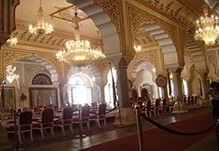
Sarvato Bhadra (Diwan-e-Khas):
Sarvato Bhadra, a square open hall with enclosed corner rooms, served as the Hall of Private Audience and hosted intimate royal ceremonies, including coronations. It is still used for religious festivals like Dusshera and Makara Sankranti, when historic kites belonging to Maharaja Sawai Ram Singh II are displayed.
A significant attraction here is the Gangajalis—the world’s largest sterling silver vessels—crafted without soldering, commissioned by Maharaja Sawai Madho Singh II to carry Ganges water to England in 1902 for King Edward VII’s coronation.
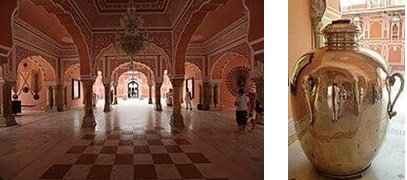 Left: Sarvato Bhadra, Right: Gangajali (Silver Urn)
Objective 7: To identify the deities and seasonal associations represented by each gate.
Pritam Niwas Chowk and Chandra Mahal:
The Pritam Niwas Chowk courtyard provides access to Chandra Mahal, featuring four exquisitely decorated seasonal gates:
1. Peacock Gate (Northeast) – Autumn, dedicated to Lord Vishnu.
2. Lotus Gate (Southeast) – Summer, dedicated to Lord Shiva-Parvati.
3. Green Gate (Northwest) – Spring, dedicated to Lord Ganesha.
4. Rose Gate (Southwest) – Winter, dedicated to Goddess Devi.
Objective 8: To explore how each level of the palace reflects aspects of royal life, from leisure to ceremony and residence.
Chandra Mahal, one of the oldest structures, rises seven floors, symbolizing Rajput auspiciousness:
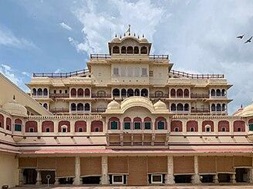 View of the Chandra Mahal from the Pritam Niwas courtyard
Sukh Niwas – House of pleasure.
Shobha Niwas – Coloured glasswork decorations.
Chhavi Niwas – Blue and white embellishments.
Shri Niwas – Residential quarters.
Mukut Mandir – Crown pavilion flying the royal standard, with a unique “one and a quarter” flag symbolizing the ‘Sawai’ title conferred by Emperor Aurangzeb on Jai Singh II.
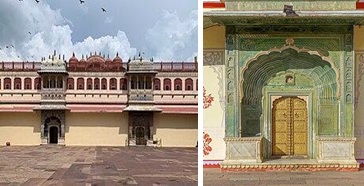 The western side of Pritam Niwas Chowk showing the
Peacock Gate (left) and the Rose Gate (right)
Objective 9: To explore how Western elements were integrated into the traditional palace landscape during the colonial era.
Mubarak Mahal and Clock Tower:
Built in 1900 by Lala Chiman Lal, Mubarak Mahal is a symmetrical structure with intricately carved marble facades. Originally a guest house for foreign dignitaries, it now houses museum offices, a library, and the Textile Gallery.
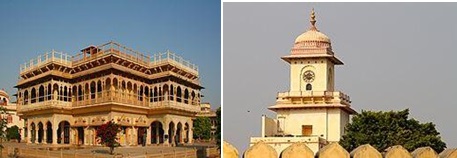 Mubarak Mahal & Clock Tower
Nearby stands the Clock Tower, a European influence added in 1873 to promote punctuality at court, with the clock sourced from Black and Murray & Co., Calcutta.
Objective 10: To appreciate the pioneering contributions of Maharaja Sawai Ram Singh II to 19th-century photography and visual documentation.
Galleries and Collections:
1. Sabha Niwas (Audience Hall):
Displays include royal portraits, Holi festival depictions, military medals, polo trophies, and elaborate murals, reflecting the grandeur of Jaipur’s royal court.
2. Textile Gallery (Mubarak Mahal):
Houses royal garments, such as Maharaja Sawai Madho Singh I’s atmasukha, Maharaja Sawai Ram Singh II’s robes, and polo outfits of Maharaja Sawai Man Singh II.
3. Sileh Khana (Arms and Armour Gallery):
Features decorated swords, shields with goddess Shila Mata motifs, 16th-century helmets, and intricate damascening in gold, showcasing Jaipur’s martial heritage
4. Painting and Photography Gallery:
Home to over 3,000 paintings reflecting Jaipur’s distinct style influenced by Mughal, Persian, and regional traditions. Notable is Sahibram’s Raas-lila painting and historic photographic collections, including zenana portraits by Maharaja Sawai Ram Singh II, who was a pioneer photographer in the 19th century.
5. Transport Gallery:
Exhibits pre-modern transport modes like buggies, palkis, and camel saddles, currently under renovation.
Objective 11: To understand the role of the MSMS II Museum Trust and its leadership in preserving the City Palace as a living heritage site through cultural, educational, and conservation initiatives.
Modern Administration and Preservation:
The palace is managed by the MSMS II Museum Trust under the leadership of Princess Diya Kumari and Rajamata Padmini Devi. The renowned historian Rima Hooja serves as the museum’s Consultant Director, overseeing curation and conservation efforts.
The City Palace remains an active symbol of Jaipur’s living heritage, seamlessly blending its historical legacy with ongoing cultural, educational, and philanthropic initiatives.
