
Objectives:
Objective 1: To know the location of Shree Haridev Mandir in Govardhan.
Objective 2: To learn the divine story behind the appearance of Lord Harideva.
Objective 3: To understand the scriptural references that highlight the devotion of the gopis.
Objective 1: To know the location of Shree Haridev Mandir in Govardhan.
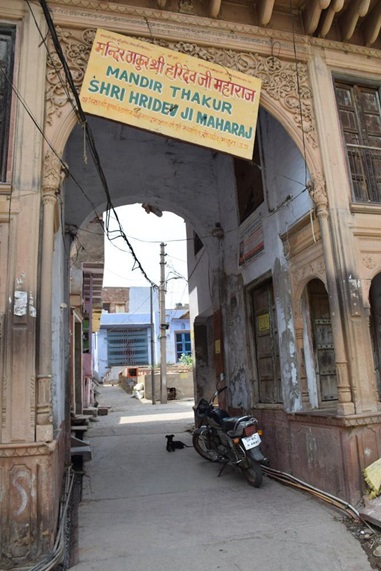
Shree Haridev temple in Govardhan is an ancient temple located 50 meter from Mānasi Ganga lake on a small street, starting from one of the banks of the sacred lake. Haridev temple is more popularly known as Shree Hardevjee mandir in Govardhan. Visiting the temple is a must for devotees who come to circumambulate around the Govardhan hill. The original temple is considered to be 5000 years old.
Story behind the divine temple:
Objective 2: To learn the divine story behind the appearance of Lord Harideva.
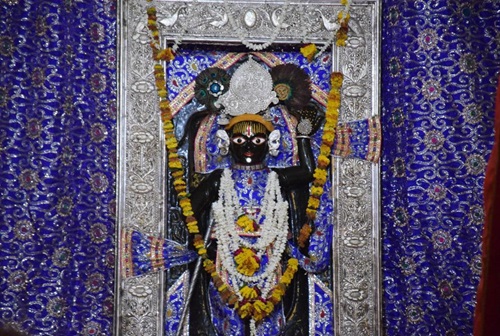
The appearance of Haridevji in Govardhan has a very divine story behind it. According to Vraja tradition, once Srimati Radharani, along with Her sakhis (gopis) and some cowherd boys (gopas), came to the banks of Manasi Ganga to meet Sri Krishna. As Krishna was late in arriving, they anxiously waited for Him. In their longing, all including Srimati Radharani began to call out to Him by His beloved name, Harideva. Their cries of “Haridev! Haridev! Haridev!” grew in intensity, and their separation became so unbearable that they were ready to give up their very lives.
Moved by their devotion, Sri Krishna suddenly manifested there in a most enchanting deity form as a beautiful seven-year-old boy, lifting Govardhan Hill with His left hand and holding a flute in His right, the very form in which He had protected the Vrajavasis from Indra’s torrential rains. Beholding this divine vision, Srimati Radharani and the gopis were overwhelmed with ecstasy. From that day onwards, they would come daily to worship Lord Harideva, offering pooja and seva at His lotus feet, honouring Him as Govardhan-nātha Harideva, the Lord of Govardhan Hill.
Scriptural Reference:
Objective 3: To understand the scriptural references that highlight the devotion of the gopis.
The profound devotion of the Gopis of Vrindavana is beautifully illustrated in the following verse from the Śrīmad-Bhāgavatam (10.32.14), which describes how Sri Krishna accepted a seat in the assembly of the gopis.
ŚB 10.32.14
tatropaviṣṭo bhagavān sa īśvaro
yogeśvarāntar-hṛdi kalpitāsanaḥ
cakāsa gopī-pariṣad-gato ’rcitas
trailokya-lakṣmy-eka-padaṁ vapur dadhat
Translation
Sri Kṛṣṇa, the Supreme Personality of Godhead, for whom the great masters of mystic meditation arrange a seat within their hearts, took His seat in the assembly of gopīs. His transcendental body, the exclusive abode of beauty and opulence within the three worlds, shone brilliantly as the gopīs worshiped Him.
The following sloka of Srimad Bhagavatam 10.31.15, gives us a glimpse of the intense devotion and affection of Gopis, who cannot withstand the separation of Sri Krishna even for a fraction of moment such as the movement of the eyelids. This sloka is part of the famous Gopi Geetam, in which the Gopis are singing towards Sri Krishna.
aṭati yad bhavān ahni kānanaḿ
truṭi yugāyate tvām apaśyatām
kuṭila-kuntalaḿ śrī-mukhaḿ ca te
jaḍa udīkṣatāḿ pakṣma-kṛd dṛśām
Translation
“When You go off to the forest during the day, a tiny fraction of a second (1/1700 of a second) becomes like a millennium for us because we cannot see You. And even when we can eagerly look upon Your beautiful face, so lovely with its adornment of curly locks, our pleasure is hindered by our eyelids, which were fashioned by the foolish creator.”
Objective 4: To describe the role of King Vajranabha and later devotees in the construction and rediscovery of the temple.
King Vajranabha, the great-grandson of Sri Krishna, constructed four grand temples — the Govindadev temple at Vrindavan, the Haridev temple at Mānasi Ganga in Govardhan, the Baladev temple near Mahavan, and the Keshavadev temple at Mathura.
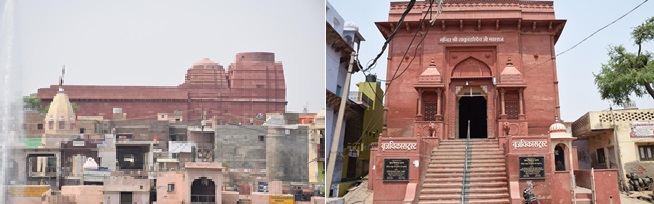
According to the local tradition, with the passing of time, the Harideva deity and His temple disappeared. Nearly 4500 years later, in the early 16th century, the deity was rediscovered during an excavation. It is also said that Sri Krishna appeared in the dream of a chief priest of that era and instructed him to carry out the excavation on the land of a local landlord. When the deity was found, none of the landlord’s family members were able to lift the deity, but the priest alone could do so. From then on, the priest began worshipping Lord Harideva with simple daily offerings, without seeking donations for temple construction. Sri Krishna again appeared in the priest’s dream and advised him to accept assistance if Raja Bhagavana Singh of Rajasthan offered to build a temple. At the same time, Raja Bhagavana Singh himself received a divine vision instructing him to construct a temple for Lord Harideva. Thus, Raja Bhagavana Singh built a grand temple at Govardhan for the worship of Sri Harideva.
Architectural Features: The temple is described as huge, beautiful, and is made of red stone.
Objective 5: To highlight the historical challenges faced during Aurangzeb’s rule and the preservation of the deity.
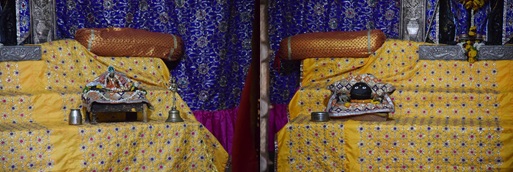
In 1670, knowing the opulence of the temples in Braj, Aurangzeb (the Muslim tyrant of Delhi) sent his army to loot and destroy the temples. The army came to loot Sri Haridev temple along with other temples of Mathura region. The then Rajput kings helped the Vaishnavas and secretly moved the deities to Rajasthan and other Hindu kingdoms. The original deity of Shrinath ji was moved to Nathdwara, Udaipur in Rajasthan and Harideva ji along with Keshavadeva were taken to Badhauli village near Rasadhan town in Kanpur district, Uttar Pradesh. Since then the replica deity of Harideva is being worshiped in the original temple at Mansi Ganga.
Relevance to Govardhan Parikrama: The Govardhan parikrama is regarded as complete only after offering darshan at the Haridev temple.
Connection to Sri Chaitanya Mahaprabhu: Sri Chaitanya Mahaprabhu also visited this temple, finding solace from his feelings of separation from Sri Krishna.
Darshan Timings:
Morning:- 05:30 AM to 11:00 AM
Afternoon:- 04:00 PM to 10:00 PM
