
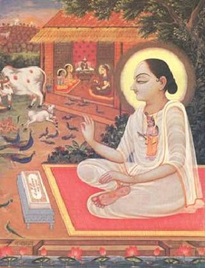
 Sri Vallabhācharya
Objectives:
Objective 1: To know the divine incarnation of Sri Vallabhācharya.
Objective 2: To describe the birth and early education of Sri Vallabhācharya.
Objective 3: To understand Sri Vallabhācharya’s devotion at Jagannath Puri.
Objective 4: To explain the divine verdict in the philosophical debate at Puri.
Objective 5: To analyse the sacred initiation mantra given to Sri Vallabhācharya.
Objective 7: To understand the purpose of Sri Vallabhācharya’s three pilgrimages.
Objective 8: To describe the significance and spread of Sri Vallabhācharya’s Baithaks.
Objective 9: To know the last message and departure of Sri Vallabhācharya.
Objective 1: To know the divine incarnation of Sri Vallabhācharya.
The element of fire played an important role throughout Sri Vallabhācharya’s life. He is seen as the incarnation of Agni, or fire (from the face of Sri Krishna).
Objective 2: To describe the birth and early education of Sri Vallabhācharya.
Sri Vallabhācharya was born in the forest named ‘Champāranya’ in India on the eleventh day of the dark half of Chaitra month (A.D. 1479) during the travel of his parents from Kashi to their native place Kankarvar in Andhra state of modern India. His father’s name was Lakshman Bhatta and mother’s name was Srimati Illammagāru.
He completed study of all religious scriptures like Veda, Puranas, Smriti, Tantra etc. and various philosophies like Sankhya, Yoga, Nyaya, Mimamsa, Jaina, Buddha etc. at the age of only 11 years.
Objective 3: To understand Sri Vallabhācharya’s devotion at Jagannath Puri.
At the young age of 11 – 12, Sri Vallabhācharya went for darshan of Lord Jagannath in Puri. It happened to be Ekadashi (the eleventh day of the lunar fortnight), a sacred day when Vallabhācharya would observe a strict fast, taking only water and refraining from eating anything.
That morning, as he entered the Jagannath Temple for darshan, a Brahmana mistakenly placed Jagannath Mahaprasad into his hand. Since Mahaprasad is considered extremely sacred and cannot be refused or thrown away, Vallabhācharya respectfully entered the temple courtyard (mandapa) holding the prasada in his right hand. Not wishing to dishonour the sanctity of Ekadashi, he stood the entire day and night in front of the deity, praising Lord Jagannath with heartfelt prayers and hymns.
Many people witnessed this young boy, standing without moving, chanting the glories of the Lord for over twenty-four hours. They were deeply impressed by his devotion and determination. The scholars and priests present there remarked that it seemed as if Sri Sukadeva Goswami himself had returned in the form of this young boy.
It is believed that the marks of Sri Vallabha’s fingers, where he rested his hand against a nearby stone wall while singing, are still visible today. It is said that even the stone melted like butter in response to his heartfelt glorification of the Lord.
Objective 4: To explain the divine verdict in the philosophical debate at Puri.
At that time, the ruler of Puri was Gajapati Maharaja Purushottam Deva, a scholarly and devout king. A major philosophical debate was taking place among the scholars at his court regarding four key spiritual questions:
- 1. Who is the chief ‘deva’?
2. Which is the top most ‘Grantha’?
3. Which is the most important ‘Mantra’?
4. Which is the most important ‘Karma’?
Each scholar gave a different opinion, leading to great disagreement. Sri Vallabhācharya, who was present, boldly declared:
- 1. Chief ‘Deva’: Sri Krishna
2. Top most ‘Grantha’: Bhagavad Gita
3. Most important ‘Mantra’: The Holy Name of Krishna
4. Most important ‘Karma’: Devotional service to Krishna
Still, some disagreed with his views. Then Sri Vallabha proposed,
“Let us place these four questions before Lord Jagannath Himself and accept His divine verdict.”
Everyone agreed. The king ordered that a blank sheet of paper, pen, and inkpot be placed before the deity inside the sanctum. The temple doors were closed. When the doors were reopened, to everyone’s astonishment, the paper had been miraculously inscribed, matching exactly the answers given by Sri Vallabha.
All present accepted this divine decision. The king joyfully honoured Sri Vallabhācharya with a garland of victory, recognizing his divine wisdom and pure devotion.
Vallabhācharya founded the Pushti Marg: the path (Marg) towards the grace (Pushti) of God.
Objective 5: To analyse the sacred initiation mantra given to Sri Vallabhācharya.
It was the night of the bright half of the sacred month of Shravana and Sri Vallabhācharya was lying restless, pitying the lot of men and women in this Kaliyuga. It was mid-night. Suddenly there appeared in person the Supreme Lord Krishna. He said to Sri Vallabhācharya: “Please don’t worry. Let such persons approach Me after your initiation with this mantra. With this assurance Bhagavan Sri Krishna granted sacred formula of initiation which is well known by the names as ‘Brahmasambandha-Mantra’, ‘Gadya-Mantra’, ‘Samarpana-Gadya’, ‘Atmanivedana-Mantra’ etc.
The meaning of the Mantra is as follows:
”For thousands of years I have been separated from my beloved Krishna. Here I lay down at his Lotus-Feet, my body, sense organs, vital breath and my mind, together with their various functions. I also lay down my worldly as well as other-worldly belongings—not only these but even my very self. Henceforth, Oh Sri Krishna! I, your humble servant, am absolutely Yours”.
Objective 6: To describe the contributions of Sri Vallabhācharya to Pushti Marg literature and devotion.
On one hand, there was the sweetest form of the Lord and on the other, there were the sweetest words on His lips. The joy of Sri Vallabhācharya knew no bounds. He placed the sacred garland round the Lord’s neck and offered Him sugar-candy. And then from Sri Vallabhacharya’s lips the sweetest Lyric ‘Madhurashtakam’ came forth, which glorifies that Krishna is the Lord of all sweetness and everything about Him is sweet.
He gave Brahma-Sambandha to many people and wrote a stotra, ‘Siddhanta Rahasya’ to explain the importance of Brahma-Sambandha and the basic principles of Pushti Marg.
The reference is:
“Shravanasyamale pakshe ekadashyam mahanishi
Sakshad bhagavata proktam tadaksharasha ucchyate”
(Siddhantarasyam-1 by Sri Vallabhacharya)
Meaning: “I reproduce here verbatim which the Lord Himself told me at midnight of the eleventh day of the bright half of the month of Shravana”.
Objective 7: To understand the purpose of Sri Vallabhācharya’s three pilgrimages.
Shri Vallabhācharya decided to go for pilgrimages so as to impart knowledge of Lord Krishna. At that time people were confused by lots of misconceptions and lots of wrong principles were prevalent in society. Shri Vallabhācharya felt the need to educate the common people and show them a right path, for this purpose he started spiritual journeys.
Shri Vallabhācharya went for three such spiritual journeys. The purpose of those spiritual journeys was to show human beings their exact position and restore the principles of Upanishads and Vedas and take them back to God by giving them the Brahma Sambandha Diksha. He opened the way of religion to everybody irrespective of Caste, Creed or Gender.
Objective 8: To describe the significance and spread of Sri Vallabhācharya’s Baithaks.
Baithak or Bethak, (‘seat’), is a site considered sacred by the followers of the Pushtimarg tradition of Vaishnava Hinduism in India for performing devotional rituals. These sites are associated with Vallabhacharya, the founder of Pushtimarg and his descendants. These sites are spread across India and are chiefly concentrated in the Vraj region in Uttar Pradesh and in western state of Gujarat. Total 142 Baithaks are considered sacred; 84 of Vallabhācharya, 28 of his son Viththalanath Gusainji and 30 of his seven grandsons.
Vallabhācharya delivered discourses on scriptures like the Vedas and Bhagavad Gita. Each Baithak marks a specific spot where Vallabhacharya engaged in spiritual discussions and teachings.
He recited and gave discourses on sacred scriptures like Vedas, Ramayana and Bhagavatam at these sites. He recited original texts from scriptures as well as gave commentaries on them. Later these commentaries were compiled in Anubhashya and Subodhini. Later small shrines were built to commemorate the event at some sites. Some sites do not have shrines or temples to mark the place but they are known only through stories and texts.
At these shrines, the hand-written manuscripts and personal artifacts of Vallabhācharya are housed which are revered by the followers. They generally don’t house images of deities. Instead, the focus is on the spiritual significance of the place itself and the teachings associated with it.
Only water and sugar crystals are offered. They too follow seven darshan schedule followed in Vaishnava Haveli temples. Followers of the Pushtimarg tradition visit these Baithaks to pay homage to Vallabhācharya and seek spiritual enlightenment.
Distribution of Baithaks:
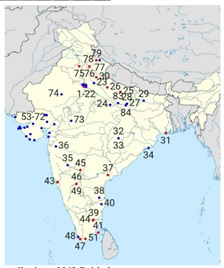
These 84 Baithaks are located from Rameswaram at the southern tip of India to Badrinath in the north, and from Narayan Sarovar and Bet Dwarka in west, to Puri in the east. Baithaks are also located at the places associated with his life such as at Tirumala Tirupati, the family’s protector deity; Champaran, his birthplace; Varanasi where he spent a significant part of his life. Baithaks are also located in the regions highly associated with Sri Krishna such as in Vraj region (now roughly corresponding to Mathura district of Uttar Pradesh) and in Dwarka in Gujarat. Baithaks from 1-22 are located in Vraj region roughly covering Mathura district of Uttar Pradesh and Baithaks from 53-72 are located in Gujarat.
Objective 9: To know the last message and departure of Sri Vallabhācharya.
When he was on the point of leaving this world, he gave a message to his sons and followers.
“My dear followers, you should always serve the Lord to the best of your ability. You should not look upon Lord Krishna as an ordinary worldly master. Once you become his, he will take care of you. But if somehow or other, you forget the Lord and think of worldly matters, you will fall.”
His incarnation was for the purpose of explaining the holy book of Bhagavata purana to all. But he did not fully accomplish it. He received orders from Bhagavan to go back to his abode. At the age of 52, on the auspicious day of Rathayatra in 1531, Sri Vallabhacharya stepped into the sacred waters of the Ganga. As he entered, a radiant bundle of light arose from his form, ascended skyward, and merged into the brilliance of the sun signifying his departure from the mortal world into the eternal realm.
