
Objectives:
Objective 1: To know the early life and background of Srila Raghunatha Dasa Goswami.
Objective 4: To learn about the role of Srila Raghunatha Dasa Goswami as Prayojana Acharya.
Objective 7: To understand the departure and samadhi of Srila Raghunatha Dasa Goswami.
Raghunatha Dasa Goswami (1495-1586) was a prominent disciple of Sri Chaitanya Mahaprabhu and one of the Six Goswamis of Vrindavan.
Early Life and Background
Objective 1: To know the early life and background of Srila Raghunatha Dasa Goswami.
Raghunatha Dasa Goswami was born in 1495 in the village of Sri Krishnapur, West Bengal, in a wealthy land owning Vaishnava family. Even as a boy, he showed signs of renunciation and devotion. He received the blessings of Srila Haridasa Thakura and, at age fifteen, met Sri Chaitanya Mahaprabhu.
Renunciation and Service to Sri Chaitanya Mahaprabhu
Objective 2: To understand the renunciation and service of Srila Raghunatha Dasa Goswami to Sri Chaitanya Mahaprabhu.
By the mercy of Lord Nityananda, Raghunatha renounced his opulent life and beautiful wife to join Sri Chaitanya in Jagannatha Puri, where he intimately served Him for sixteen years under the guidance of Svarupa Damodara Goswami. Sri Chaitanya Mahaprabhu personally gave him a Govardhana Shila and gunja-mala as tokens of His love.
Bhajana at Radha-kunda
Objective 3: To describe Srila Raghunatha Dasa Goswami’s bhajana and spiritual practices at Radha-kunda.
Unable to bear the separation after the disappearance of Sri Chaitanya, Raghunatha planned to give up his life at Govardhana Hill, but was lovingly stopped by Sri Rupa and Sanatana Goswamis. He then stayed at Radha-kunda and engaged in intense bhajana for over forty years.
Every day, he:
Chanted 64 rounds of japa (100,000 names),
Offered 1,000 obeisances to Sri Krishna and 2,000 to Vaishnavas,
Performed manasi-seva in his siddha-deha,
Worshiped his Govardhana Shila,
Bathed three times in Radha-kunda,
Ate only a small leaf cup of buttermilk (or nothing at all).
He embodied renunciation to its highest standard, surviving on almost nothing after the disappearance of the other Goswamis.
Revealing the Highest Spiritual Ideal – Prayojana Acharya
Objective 4: To learn about the role of Srila Raghunatha Dasa Goswami as Prayojana Acharya.
Srila Raghunatha Dasa Goswami is revered as the Prayojana Acharya, the one who revealed the ultimate goal of life—loving service to Srimati Radharani. In Vilapa-kusumanjali, he passionately cries out for Srimati Radharani’s mercy.
Restoration of Radha-kunda and Shyama-kunda
Objective 5: To highlight the restoration of Radha-kunda and Shyama-kunda by Srila Raghunatha Dasa Goswami.
Raghunatha Dasa initially hesitated to restore the sacred kundas, considering them eternally perfect. But when a wealthy pilgrim from Badrikashrama approached him, stating he had been sent by Sri Badri-Narayana to fund the restoration, he accepted this as divine will.
Radha-kunda was shaped into a perfect rectangle.
Shyama-kunda was meant to match, but five trees revealed themselves as the Pandavas and requested not to be cut down.
To honor them, the kunda was left slightly crooked, just like Sri Sri Krishna’s form.
This restoration is one of Raghunatha’s most lasting contributions, preserving these sacred lakes for all future generations.
Miraculous Pastimes
Objective 6: To know the miraculous pastimes connected with the life of Srila Raghunatha Dasa Goswami.
Sanatana Goswami once saw Sri Krishna guarding Raghunatha from wild tigers and Srimati Srimati Radharanirani shading him from the scorching sun.
Sanatana chastised him for accepting direct service from their Lordships and instructed him to build a small hut, which later became his bhajana-kutira.
Another incident includes:
Emperor Akbar and his vast army were extremely thirsty. Directed by Raghunatha to Kali-kheta and Gauri-kheta, they drank fully—yet the water did not decrease, a testament to his divine potency.
Departure and Samadhi
Objective 7: To understand the departure and samadhi of Srila Raghunatha Dasa Goswami.
After more than 40 years of intense bhajana, Srila Raghunatha Dasa Goswami entered into nitya-lila on Shukla Dvadashi in Padmanabha Masa, 1586 (October 23). This date is also the disappearance tithi of:
Srila Raghunatha Bhatta Goswami, and
Srila Sri Krishnadasa Kaviraja Goswami.
Samadhi Mandir and Bhajana-kutira at Radha-kunda
Objective 8: To describe the location and layout of Srila Raghunatha Dasa Goswami’s samadhi mandir and bhajana-kutira.
His samadhi mandira stands on the banks of Radha-kunda, beside his bhajana-sthali, where he would chant daily.
Though the original hut no longer exists, a cement structure has replaced it.
Location and Layout
Location:
● Place: Radha-kunda, Govardhan, Uttar Pradesh, India
● Setting: Located just beside Radha-kunda, at the foot of Govardhan Hill, in the heart of Braj Mandal.
Nearby Sites:
Shyama-kunda – a few steps away
Jahnava Baithak – nearby
Lalita-kunda and Kusuma Sarovara – short walking distance
The path of Govardhan Parikrama runs just adjacent to the area.
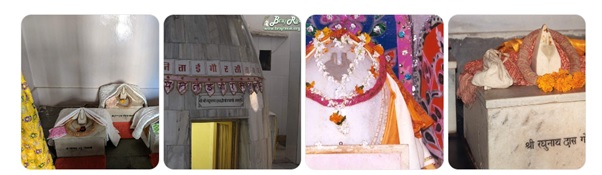
Above are four photographs of the Samādhi Mandir (tomb-shrine) of Śrī Raghunātha Dāsa Gosvāmī, located on the banks of Srimati Radharani-Kund.
The first image shows the small dome-shaped memorial marking the exact spot where he sat daily in japa (chanting) and later entered samādhi.
The second offers a broader view of the shrine structure with surrounding walls and modest decorations in the courtyard.
The third image captures garlands and offerings placed around the sanctified tomb.
The fourth highlights the name plate and marble facade of the samādhi mandir.
Spiritual Significance
Objective 9: To highlight the spiritual significance and darshan experience of Srila Raghunatha Dasa Goswami’s Samadhi Mandir.
This samadhi is more than a historical site—it’s a place where seekers come to imbibe the spirit of vairagya (renunciation) and raga-bhakti (spontaneous devotional love) that Raghunatha Dasa Goswami exemplified. He is regarded as one of the deepest contemplatives of the pastimes of Srimati Radharani and Sri Krishna, and his written works such as Manah-shiksha and Vilapa-kusumanjali continue to inspire spiritual aspirants worldwide.
Darshan of Samadhi Mandir:
Pilgrims and tourists visiting Govardhan often include this mandir in their parikrama (circumambulation) of the holy sites. The atmosphere is serene, especially in the early mornings, when devotees chant softly and absorb the sacred vibrations.
While the samadhi is not grand in architecture, its spiritual potency is deeply felt by those who come with sincere hearts. Visiting this spot offers a rare opportunity to connect with one of the most intimate servants of Sri Chaitanya and Srimati Radharani-Sri Krishna.
Thus Raghunatha Dasa Goswami Samadhi Mandir is not just a monument—it is a gateway to the world of divine love and renunciation. Whether one is a pilgrim, a spiritual seeker, or a student of Indian devotional traditions, this sacred site offers a moment of reflection, inspiration, and connection with the legacy of one of Gaudiya Vaishnavism’s greatest saints.
