
Objectives:
Objective 1: To understand the importance of Apsara Kunda in spiritual life.
Objective 2: To learn the origin of Apsara Kunda and Navala Kunda.
Objective 3: To identify the temples near Apsara Kunda.
Objective 4: To understand the history behind Apsara Kunda and Navala Kunda.
Objective 5: To explore Narasingha Mandira and its significance.
Nestled at the southernmost tip of Govardhan Hill, Apsara Kunda is accompanied by the nearby Navala Kunda.
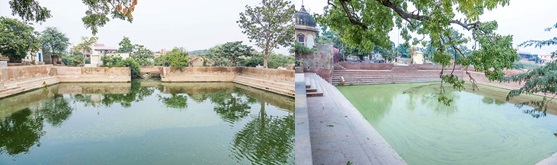 Apsara Kunda & Navala Kunda
Objective 1: To understand the importance of Apsara Kunda in spiritual life.
Apsara-kunda is a serene and sacred place filled with divine pastimes and spiritual significance. It is believed that Srimati Radharani and Sri Krishna performed their spring rasa-lila here, filling the air with divine melodies of love and devotion.
Apsara-kunda is more than just a sacred waterbody; it is a gateway to experiencing the timeless pastimes of the Divine Couple. Bathing here is said to grant one the benefit equal to performing hundreds of rajasuya-yajnas and ashvamedha-yajnas.
Objective 2: To learn the origin of Apsara Kunda and Navala Kunda.
When the demigods came to bathe Lord Krishna, the sacred water from His abhisheka formed 108 kundas. Among them, Apsara Kunda was created when Indra and the seven principal apsaras from heaven arrived to perform the abhisheka of the Lord, joyfully dancing at the spot. The name also honors Srimati Radharani, whose dancing in the rasa-lila surpassed that of all heavenly apsaras.
Navala Kunda derives its name from Navala Kishore, a beautiful name of Krishna meaning “ever-fresh youth.” It is also known as Punchari Kunda because it is situated at the very “tail” (punchari) of Govardhan Hill.
Objective 3: To identify the temples near Apsara Kunda.
On the bank of Apsara Kunda stands the Apsara-bihari Temple, Dauji Temple, and a small Apsara-isvara (Siva-linga) shrine. Nearby are the Apsaravihari Temple, Kundeshwar Mahadev Temple and Raghav Pandit’s cave.
Objective 4: To understand the history behind Apsara Kunda and Navala Kunda.
Scriptures reveal that twenty-four incarnations of Lord Vishnu including Matsya, Kurma, Varaha, and Vamana eternally perform their pastimes on the banks of Apsara Kunda.
Krishna often came here to please His friends, sometimes manifesting forms like:
A twelve-armed Vishnu before the gopis,
Varaha, digging the Earth,
Lord Ramachandra, with the cowherd boys taking the forms of monkeys and bears assisting in building the bridge to Lanka.
Another legend states that once Srimati Radharani and Sri Krishna were dancing on the banks of Apsara Kunda during the spring rasa-lila. Absorbed in love, They melted into liquid love, forming two kundas — Srmati Radharani became Apsara Kunda, and Sri Krishna became Navala Kunda. The area remains surrounded by dense groves and Kadamba trees, preserving the rasa-lila atmosphere.
Objective 5: To explore Narasingha Mandira and its significance.
On a small hill overlooking Apsara Kunda stands the Narasingha Mandir, housing a very ancient deity of Lord Narasingha said to be about one thousand years old. The deity depicts Narasingha ripping apart Hiranyakashipu, with Prahlada Maharaja standing nearby offering prayers. Narasingha is the half-man, half-lion incarnation of Lord Vishnu who appeared to protect His devotee Prahlada from his demonic father.
