
Objectives :
Objective 1: To know about the architectural features of the Hawa Mahal.
Objective 2: To learn the historical context and purpose behind the construction of Hawa Mahal.
Objective 1: To know about the architectural features of the Hawa Mahal.
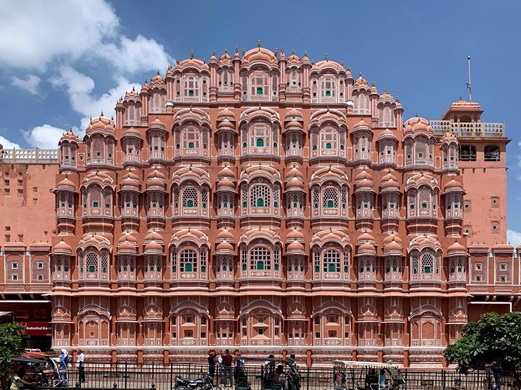
The Hawa Mahal, part of the City Palace complex, is a familiar landmark, and looks like a series of pierced windows placed in tiers to overlook the street below.
Maharaja Pratap Singh built this odd pyramidal-shaped, five-storeyed structure in 1799. The top three floors of this uniquely designed building are just a room deep while the lower sections have connected rooms and courtyards.
The tapering façade with 953 latticed windows, perforated screens and projecting balconies lend a delicate fringe to this airy structure, which is actually the rear portion of the building. Its purpose was simply to allow the royal women a view of ceremonial processions while seated behind the small windows, allowing them to look out without themselves being seen.
The honeycomb shaped and beautifully carved windows allow breeze to blow through the palace and makes it a perfect summer palace. It was built as an extension to the City Palace nearby.
Objective 2:To learn the historical context and purpose behind the construction of Hawa Mahal.
In 1799, the Kachhwaha Rajput ruler, Sawai Pratap Singh, grandson of Maharaja Sawai Jai Singh ordered Lal Chand Usta to construct an extension to the Royal City Palace. The Purdah system at the time was strictly followed. Rajput royal ladies should not be seen by strangers or appear in any public area. The construction of Hawa Mahal allowed the royal ladies to enjoy every day street scenes and royal processions on the street without being seen.
Architecture
The five-storey palace was built in the form of Krishna’s crown because Sarai Pratap Singh was devoted to Lord Krishna.
The mahal has a total of 953 small casements each with a small lattice-worked pink window, balconies and arched roofs with hanging cornices. This allowed a cool breeze to blow through the mahal and keep it cool and airy in summer. Despite the large number of windows, each of them is the size of a peep hole such that the royal ladies were not seen by the public.
The top three storeys are named Vichitra Mandir, Prakash Mandir and Hawa Mandir. The Maharaja worshipped Krishna at the Vichitra Mandir, while the Prakash Mandir provides an open terrace to both sides. Worth noting is that there are no steps to the upper floors but ramps. They are for the palanquin of the royal ladies.
The autumn celebrations took place on the Sharad Mandir on the first floor. The colourful glassworks on Ratan Mandir on the second floor are not to be missed. The entry to the Hawa Mahal from the city palace side is through an imperial door. It opens into a large courtyard, which has double-storeyed buildings on three sides, with the Hawa Mahal enclosing it on the east side. An archaeological museum is also housed in this courtyard.
The cooling effect in the chambers, provided by the breeze passing through the small windows of the façade, was enhanced by the fountains provided at the centre of each of the chambers.
The top two floors of the Hawa Mahal are accessible only through ramps. The Mahal is maintained by the archaeological department of the Government of Rajasthan.
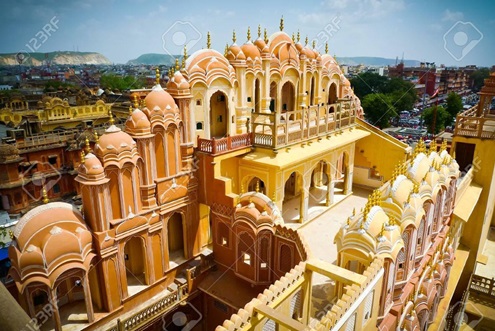 Top View Hawa Mahal
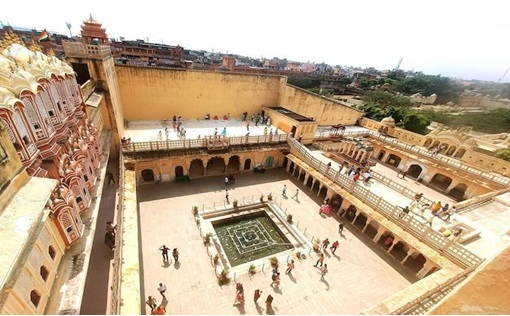 Inside View Hawa Mahal
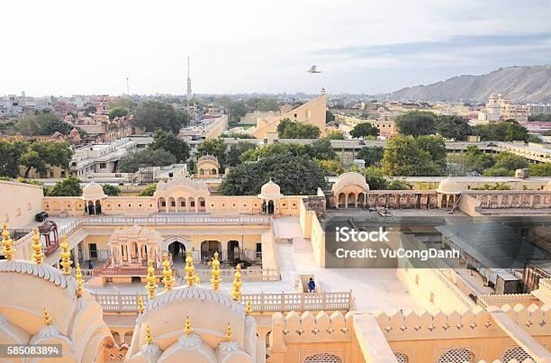 View of Jantar Mantar from Hawa Mahal
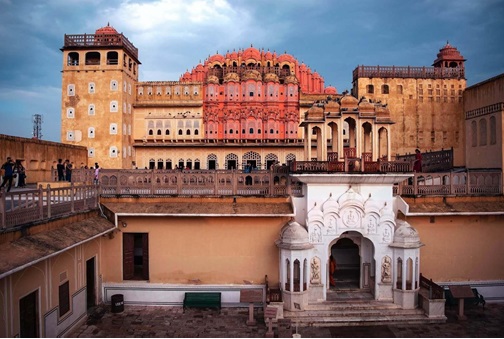 View of Entrance of Hawa Mahal
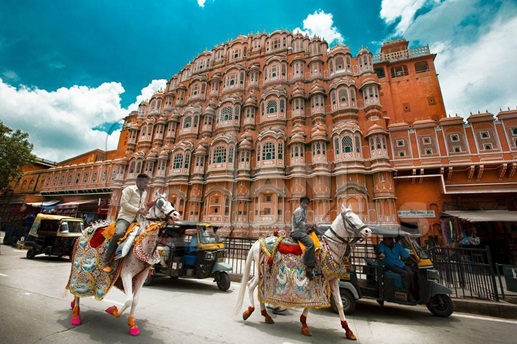 Horse Ride at Hawa Mahal
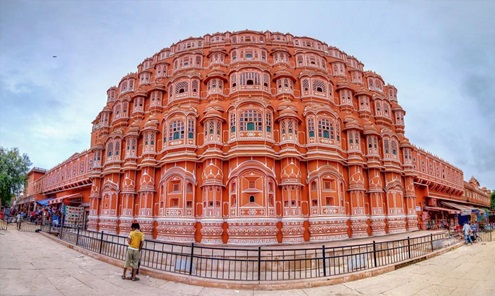 Eye View of Hawa Mahal
