Objectives:
Objective 1: To understand the historical and religious significance of Galta Ji Temple .
Objective 1: To understand the historical and religious significance of Galta Ji Temple.
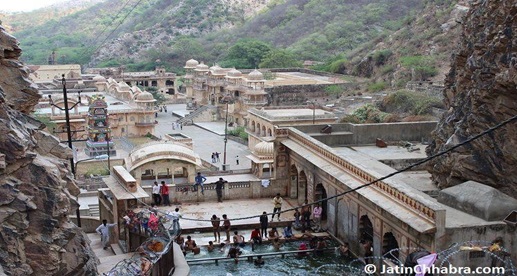
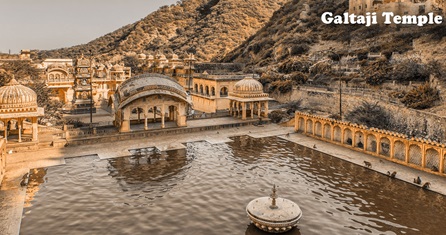
Galta Ji Temple, one of the most sacred and scenic pilgrimage sites near Jaipur. Surrounded by the Aravalli hills and rich in mythological and historical lore, Galta Ji is not just a destination—it’s a journey into India’s devotional heart.The temple complex is a cluster of shrines built around natural springs that feed seven sacred water tanks, or kunds. Among them, the Galta Kund is regarded as the holiest and is never dried up, drawing thousands of pilgrims who bathe here to wash away sins, especially during Makar Sankranti and Kartik Poornima.
Its religious importance traces back to Satyuga, with legends stating that Saint Galava performed intense penance here. Pleased with his devotion, the Gods brought the holy Ganges to Galta Ji through a cow’s mouth (Gau-mukh). As per the sacred text Galvashram Mahatmaya, the holy trinity—Brahma, Vishnu, and Mahesh—visit the site every Kartik Poornima, making it immensely auspicious.
The historical significance is further deepened by the contributions of Ramanandi saints, notably Krishnadas Payo Hari, who sanctified the site, and Diwan Rao Kriparam, who built the existing temple complex in the 18th century under the patronage of Maharaja Sawai Jai Singh II. Over time, Galta Ji has become not only a place of spiritual purification but also a center of learning, devotion, and monastic tradition, known for its connection with the Galta Peeth and lineage of Acharyas. It stands today as a living symbol of Jaipur’s Vaishnava devotion, rich in legend, history, and sanctity.
Objective 2: To learn how the temple’s design mixes traditional Indian and Rajasthani styles, using painted walls (frescoes) and dome-shaped pavilions (chhatris)
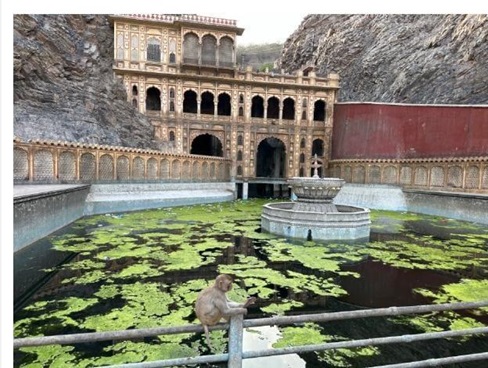
The architecture of Galta Ji Temple is a striking reflection of Rajasthani aesthetics blended seamlessly with classical Indian temple design. Built primarily during the 18th century under the patronage of Diwan Rao Kriparam and Maharaja Sawai Jai Singh II, the temple complex was constructed in the traditional haveli-style layout, evoking the feel of a sacred royal residence.
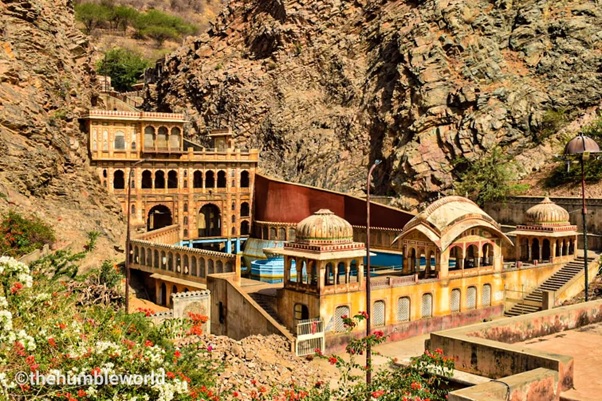
The complex features intricately designed chhatris (domed kiosks), multi-arched gateways, and a series of pavilions and temples arranged along a natural mountain pass. The buildings are made of pink sandstone and white marble, with the main shrine overlooking the sacred Galta Kund.
The visual rhythm of pillared halls, arched facades, and terraced tanks creates a dynamic spatial experience for pilgrims and visitors.The walls and ceilings of the temples are adorned with frescoes and mural paintings, many of which depict mythological scenes, Vaishnava deities, and episodes from the lives of saints. These artistic embellishments not only serve decorative purposes but also function as a visual theology, narrating the temple’s sacred lineage.
Out of all the temples in the Galta Ji complex, Shri Gyan Gopal Ji temple & Shri Sitaram Ji temple are constructed in haveli style. The Shri Sitaram Ji Temple is the biggest among all temples at Galta Ji. The Deity of Shri Ram Gopal Ji at the Sitaram Ji Temple is regarded as embodying the features of both Lord Rama and Lord Krishna.
The legend behind the deity being similar to both Lord Rama and Lord Krishna is that Lord Krishna appeared before Tulsidas in the form of Lord Rama and Tulsidas described what he saw. Hence, the resemblance.
The Hanuman temple in the complex is renowned for its Akhand Jyoti (eternal lamp), whose flame has been continuously burning for centuries, ever since the consecration of Hanuman Ji’s murti. While some consider this beyond the realm of belief, many still hold faith in such legends.
The Shri Gyan Gopal Ji Temple compound houses a school for students and disciples. There is a pretty idol of Lord Krishna inside the Gyan Gopal ji Temple. There are several small temples inside the Galta Ji complex that stretch from the Galta Gate to Shri Sitaram Ji Temple.
Galwar Bagh Gate and Others
The Galwar Bagh Gate is the main gate at the entrance of the Galta Ji Temple. The prominent gate is a huge structure in pink that houses all temples inside the complex. The other impressive structures or temples to watch out for, inside the complex are the Brahma Temple, The Vishnu Temple and the Galta Kund. They are all must visit.